
 Subtica Team
12 min read
Grow Revenue With Predictive Customer Lifetime Value Analytics
Every customer contributes to your business – but some stay longer, spend more, and drive meaningful growth. Customer Lifetime Value (LTV) reveals who these users are by showing how much revenue each customer generates over time and how deeply they engage with your product. That’s why LTV is one of the core metrics for building sustainable, long-term success.

But knowing your LTV is just the starting point. Real progress comes from understanding what shapes this metric – and how to improve it. In this guide, we break down the essentials of LTV for SaaS products in general and subscription apps in particular: how to calculate it, which benchmarks matter, and the strategies that actually help this grow.

What Is Customer Lifetime Value?
Customer Lifetime Value measures the total revenue a single user generates throughout their entire relationship with your app – from the first signup to the day they cancel. For subscription-based mobile apps and SaaS products, LTV isn’t just a number; it’s a clear indicator of long-term growth.
LTV depends on several key factors: how long a user stays, how often they pay, which subscription plans they choose, and how actively they engage with your app. Even small improvements in retention rate, average revenue per user (ARPU), or engagement can boost LTV more effectively than expensive advertising campaigns.
Consider Starbucks: a customer may buy a $5 coffee today, but their real value comes from returning week after week. The same principle applies to subscription apps – ongoing engagement and recurring subscriptions create true revenue, not the initial payment.
Understanding LTV helps you allocate marketing budgets effectively, identify high-value segments, optimize in-app features, and ensure sustainable, long-term growth for your SaaS product.
Why LTV Matters for Subscription Apps?
For subscription apps, understanding LTV goes beyond tracking sign-ups or monthly payments. LTV shows the long-term value of each user, helping app developers identify high-value customers, optimize mobile app analytics, and focus on growth strategies that really matter. Investing in app engagement and product improvements is often more cost-effective than constantly acquiring new users.

Note
According to Harvard Business Review, acquiring a new customer can cost 5–25 times more than retaining an existing one. Yet many companies still focus primarily on average value, missing opportunities to grow faster through long-term, loyal customers.
LTV also informs strategic decisions. For example, if improving onboarding, adding features, or enhancing customer support boosts retention, resources can be allocated more effectively. Focusing on LTV ensures a steady revenue stream and gives subscription apps the flexibility to invest in growth confidently. Prioritizing customer retention over short-term acquisition builds loyal users who remain engaged for the long term – a key advantage in a competitive app marketplace.
In short, LTV is more than just a metric. It’s a growth framework that turns each customer into a long-term partner, guiding decisions that increase subscription revenue, enhance mobile app analytics, and drive sustainable success.
What Metrics Do You Need to Track for LTV?
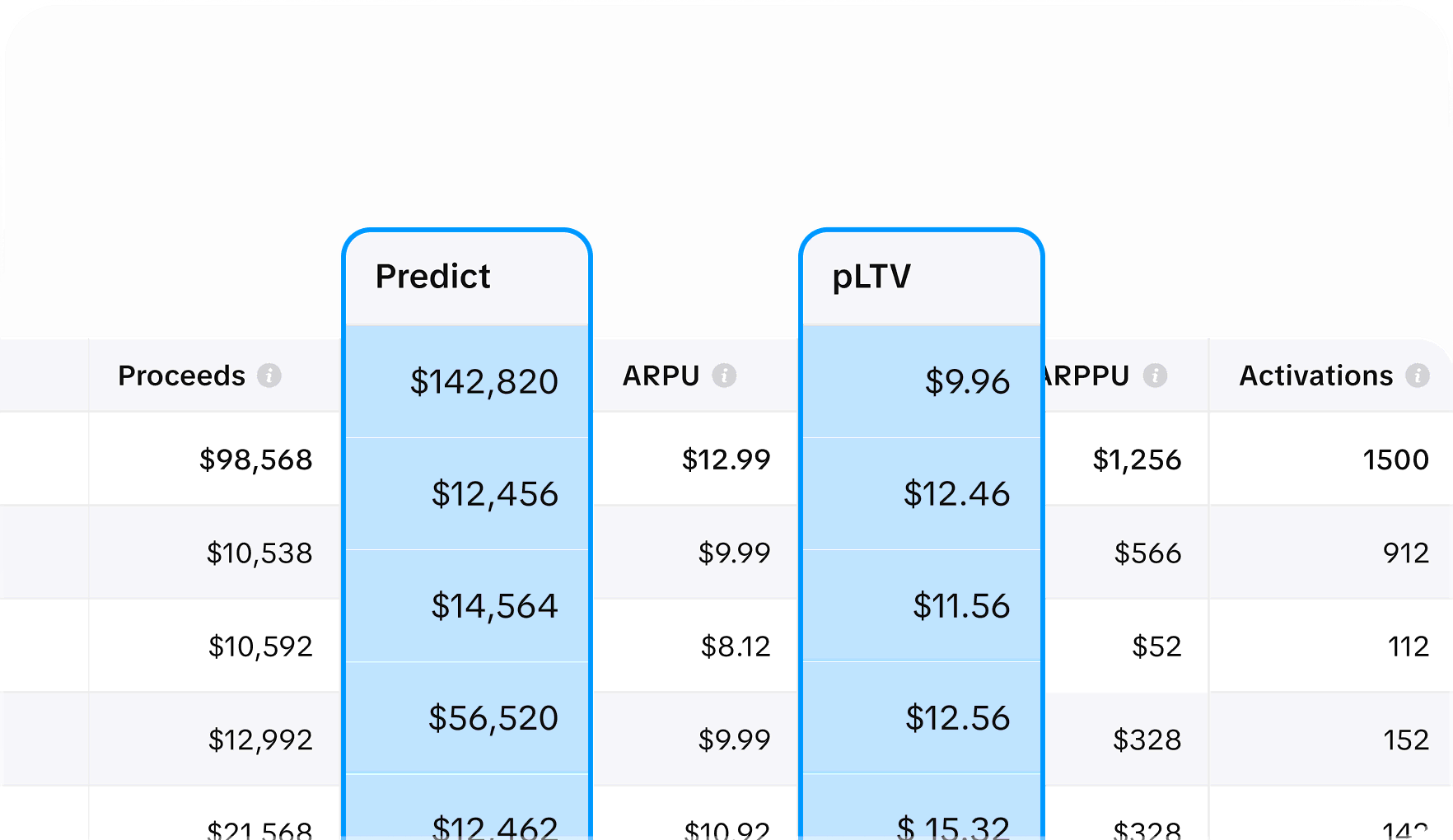
To calculate LTV for subscription apps, it’s essential to monitor several core metrics. These figures not only feed into the LTV calculation but also act as early indicators of trends that can impact customer value.
Average Revenue Per User (ARPU) measures how much revenue each customer generates on average over a specific timeframe, such as a month, quarter, or year. Divide total revenue by the number of active customers in that period to get ARPU. For subscription apps, this often aligns closely with the
Customer Acquisition Cost (CAC) represents the total expense of acquiring a new customer, including marketing and sales costs. While CAC doesn’t enter the basic LTV formula, it’s critical for evaluating profitability. A sustainable business generally requires that LTV significantly exceeds CAC.
Churn Rate tracks the percentage of users who cancel their subscriptions during a given period. It’s essentially the inverse of the retention rate. Churn directly affects LTV: lower churn means users stay longer, increasing the total revenue they generate. To calculate it, divide the number of lost customers by the total customer base at the start of the period and multiply by 100%.
Customer Lifetime (CL) reflects the average duration a user remains subscribed and continues paying for your service. This metric varies across apps and depends heavily on customer retention strategies. The longer a user stays, the higher their lifetime value. CL is usually calculated by averaging the tenure of all customers before they churn.
Discount Rate comes into play in advanced LTV models, particularly for subscription apps with large upfront costs. This rate accounts for the time value of money, converting future revenue into present value and giving a more accurate picture of a customer’s financial worth.
By tracking these metrics, app developers can accurately estimate LTV and make data-driven decisions to improve retention, revenue, and long-term growth.
How to Calculate LTV for Subscription Apps?
Calculating Customer Lifetime Value (LTV) for a SaaS product or subscription app can be done in different ways. Below are two practical approaches: a simple method to understand the core logic of LTV, and a more advanced version designed for subscription-based products with recurring revenue. Both options can be done manually, without complex models.
Simple Method
The basic LTV calculation uses three core metrics: Average Revenue Per User (ARPU), Customer Lifetime, and Churn Rate. The formula is:
Where:
- ARPU – average revenue per user for a chosen period (e.g., monthly).
Formula:
- Customer Lifetime – the average time a user stays subscribed.
Formula:
Example: Suppose your app had 450 active users at the beginning of the month, gained 150 new subscribers, 28 canceled, and total revenue for the month was $18,000.
- End Users = 450 + 150 − 28 = 572
- Average Number of Active Users = (450 + 572) ÷ 2 ≈ 511
- ARPU = $18,000 ÷ 511 ≈ $35.23
- Churn Rate = 28 ÷ 450 ≈ 0.062 (6.2%)
- Customer Lifetime = 1 ÷ 0.062 ≈ 16.1 months
- LTV = $35.23 × 16.1 ≈ $567
If your Customer Acquisition Cost (CAC) is $50 per user:
Adjusted LTV = $567 − $50 = $517
Advanced Method
For more accurate projections, the advanced method incorporates a discount rate to reflect the time value of money. It discounts future subscription revenue, which makes the calculation more realistic for apps with monthly or yearly plans. The formula is:
Where:
- t = time period (usually months)
- n = total number of periods for the projection(often a year, so n = 12)
- Discount Rate – monthly discount rate (e.g., inflation or cost of capital)
Example: Using the above numbers with a 0.6% monthly discount rate, the annual LTV would adjust to roughly $560, giving a realistic perspective on each customer’s contribution over time.
Calculating LTV with Subtica
Accurately predicting LTV becomes increasingly challenging as your app scales. The more variables you need to consider – retention patterns, user segments, cohort behavior, purchase frequency, and more – the more complex manual calculations become. This is exactly where Subtica steps in.
Subtica is an all-in-one revenue intelligence platform built to help subscription apps grow smarter and faster. It empowers teams to understand user behavior, improve conversion flows, and increase revenue through data-driven decisions rather than guesswork.
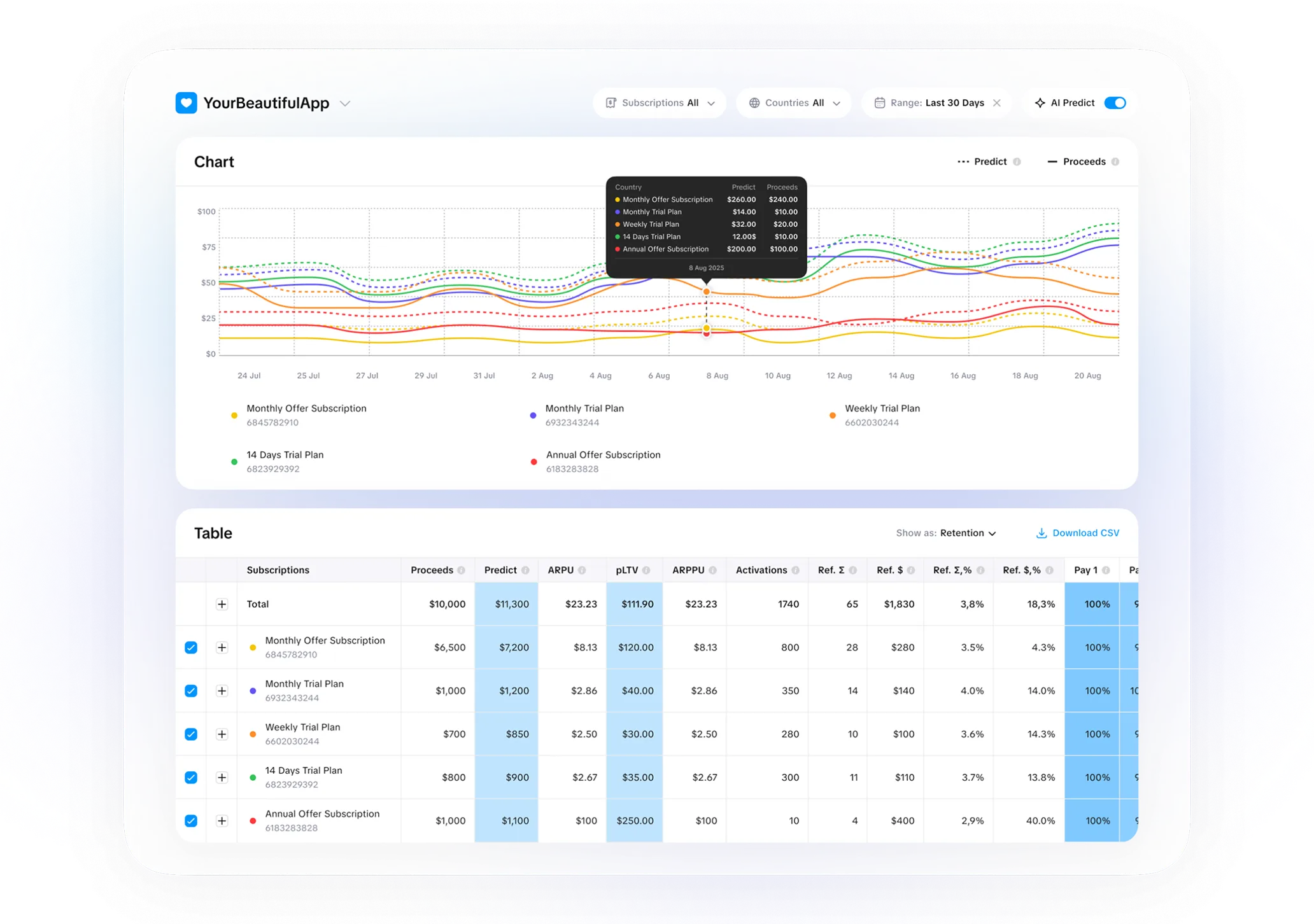
One of Subtica’s core advantages is its advanced subscription analytics engine. By connecting directly to the App Store, Subtica delivers highly accurate insights into your users, purchases, refunds, renewals, and subscription lifecycle events. You can analyze cohorts, track ARPU, monitor churn, and instantly understand how user behavior evolves over time.
But what truly elevates Subtica is its AI-powered LTV prediction technology. Subtica’s machine learning models continuously analyze your app’s historical patterns – purchase activity, pricing distribution, user engagement, trial performance, and more. These models forecast the future value of each cohort with remarkable precision, helping you clearly understand long-term revenue potential.
With Subtica’ LTV predictions, you can:
- Identify your highest-value user segments
- Optimize acquisition spend based on projected return
- Choose strategies that maximize retention and increase revenue
- Forecast future cash flow with confidence
In other words, Subtica turns LTV from a complex calculation into a practical, everyday tool for decision-making. Ready to maximize your subscription revenue? Try Subtica now and turn data into growth.
What Is a Good LTV for Subscription Apps?
Defining what counts as a “good” Customer Lifetime Value (LTV) for subscription apps isn’t straightforward. The number varies widely depending on your business model, market niche, pricing strategy, and even how much you spend on acquiring users. Instead of looking for a single universal benchmark, it’s more accurate to evaluate LTV through a combination of key metrics that show the true health of your subscription business.
LTV to CAC Ratio: Your Most Reliable Indicator
One of the clearest ways to understand whether your subscription model is sustainable is to track the LTV to CAC ratio. This metric compares how much value you get from a customer over their lifetime to how much you paid to acquire them. A healthy benchmark across the industry is LTV ≈ 3× CAC. However, early-stage apps often operate with lower ratios as they optimize their product.
For example, if your average CAC is $20, you should aim for an LTV of around $60 or more. If your marketing campaigns don’t reach profitability, it’s a sign to adjust pricing, paywalls, user onboarding, or acquisition channels.
Business Model and Pricing: Value Isn’t Just About Cost
Your pricing structure has a major influence on LTV, but a higher subscription price doesn’t always guarantee better performance. Enterprise or specialized tools may have higher CAC but extremely long customer lifetimes, driving LTV far above the industry average. On the other hand, widely accessible apps priced at $5–15 per month rely on volume and strong user engagement to stay profitable.
In subscription businesses, the real driver of LTV is not the price itself but how consistently users return and continue finding value in the product.
Market Segment and Competition
Different categories naturally produce different LTV benchmarks. Niche apps operating in professional markets – like education, fitness coaching, or productivity for specific industries – often achieve higher LTV due to stronger loyalty and fewer competitors. In contrast, broad categories like “lifestyle” or “entertainment” face higher churn and shorter subscription cycles.
Gaming subscriptions are a special case: they often grow quickly but may have shorter lifetimes. Still, well-designed progression mechanics and value loops can significantly extend the revenue per user.
Retention and Expansion Revenue: The Core of High LTV
High LTV always stems from strong retention. When users consistently return and engage, they naturally generate more revenue over time, regardless of how much you initially paid to acquire them. Expansion revenue – such as upsells, plan upgrades, or additional features – can further multiply the lifetime value of each subscriber.
For instance, an app might start users on a $9.99 monthly plan, but a portion of the audience later upgrades to annual billing or purchases add-ons, effectively doubling or tripling their long-term value.
Industry Benchmarks for LTV
While exact numbers vary, here are general benchmarks across subscription categories:
- Gaming subscriptions: 4–7 months average lifetime
- General consumer subscription apps: 10–14 months
- Niche/professional apps: 18+ months
With typical subscription prices ranging from $10–30 per month, most apps see an LTV between $60 and $450, although B2B or specialized products can exceed these ranges significantly.
Conclusion
Customer Lifetime Value (LTV) is one of the most reliable indicators of long-term health for any subscription app. It reflects how much revenue each user brings over time and helps you understand where to focus your energy to achieve sustainable, predictable growth. Whether you’re improving onboarding, refining your paywall, strengthening retention, or introducing smarter upgrade paths – every improvement contributes to a stronger LTV.
Growing a subscription business is never a one-time effort. It’s an ongoing process that requires continuous analysis, thoughtful product iterations, and a deep understanding of user behavior. Think of LTV as your strategic compass and the LTV/CAC ratio as the pace that keeps you moving forward.
Stay committed, iterate consistently, and let data guide your next steps – and you’ll watch your subscription app evolve into a stronger, more scalable business.
Ready to maximize your LTV and grow your subscription revenue? Start using Subtica today and unlock actionable insights that drive long-term success.
Want to Apply These Insights to Your App?
Track subscription metrics, reduce churn, and scale your iOS app revenue with Subtica’s subscription analytics platform.


Related Articles

Subscription Analytics Dashboard for SaaS: Data-Driven Metrics and Revenue Insights for iOS Apps
Subscription analytics helps SaaS and subscription businesses turn data into valuable insight. Learn how subscription analytics software tracks subscription metrics, payments, and performance with customizable dashboards, charts, and one-click reports.
Subtica Team

Subscription Business Metrics to Track: Essential SaaS Metrics for Every Subscription Business
Discover the key subscription metrics every business should monitor. Learn which key metrics SaaS companies and subscription businesses use, the most important metric to track, and how a strong analytics system helps monitor subscription metrics and growth.
Subtica Team

Predictive Analytics Examples, Applications, and Algorithms for Subscription Apps
Predictive analytics helps businesses forecast trends using algorithms and data models. Learn how predictive analytics works, key use cases like fraud detection, and how companies use predictive analytics to forecast future outcomes.
Subtica Team

Predictive Analytics Definition: What Is Predictive Analytics and How It Works
Predictive analytics uses machine learning, data mining, and statistical models to predict future outcomes. Learn the predictive analytics definition and how businesses use predictive analytics with historical data and current data to forecast trends.
Subtica Team

Customer Churn Rate Analysis for SaaS: How to Calculate Churn Rate, Perform a Churn Analysis, and Improve Retention
Learn how to calculate customer churn rate with practical churn analysis techniques. Understand customer churn, revenue churn, and retention metrics while analyzing your churn to improve retention and reduce churn rate.
Subtica Team
ARR Revenue: Annual Recurring Revenue Calculation, Recurring Revenues & How to Calculate ARR for SaaS Business Billing
ARR revenue (annual recurring revenue) is a core metric for subscription and SaaS business models. In this guide to annual recurring revenue, learn how to calculate ARR, understand recurring revenues, and improve revenue growth. Discover ARR calculation methods, why this SaaS metric matters, and how annual recurring revenue supports predictable subscription business performance.
Subtica Team
MRR (Monthly Recurring Revenue): How to Calculate MRR and Use MRR to Grow Your Subscription Business
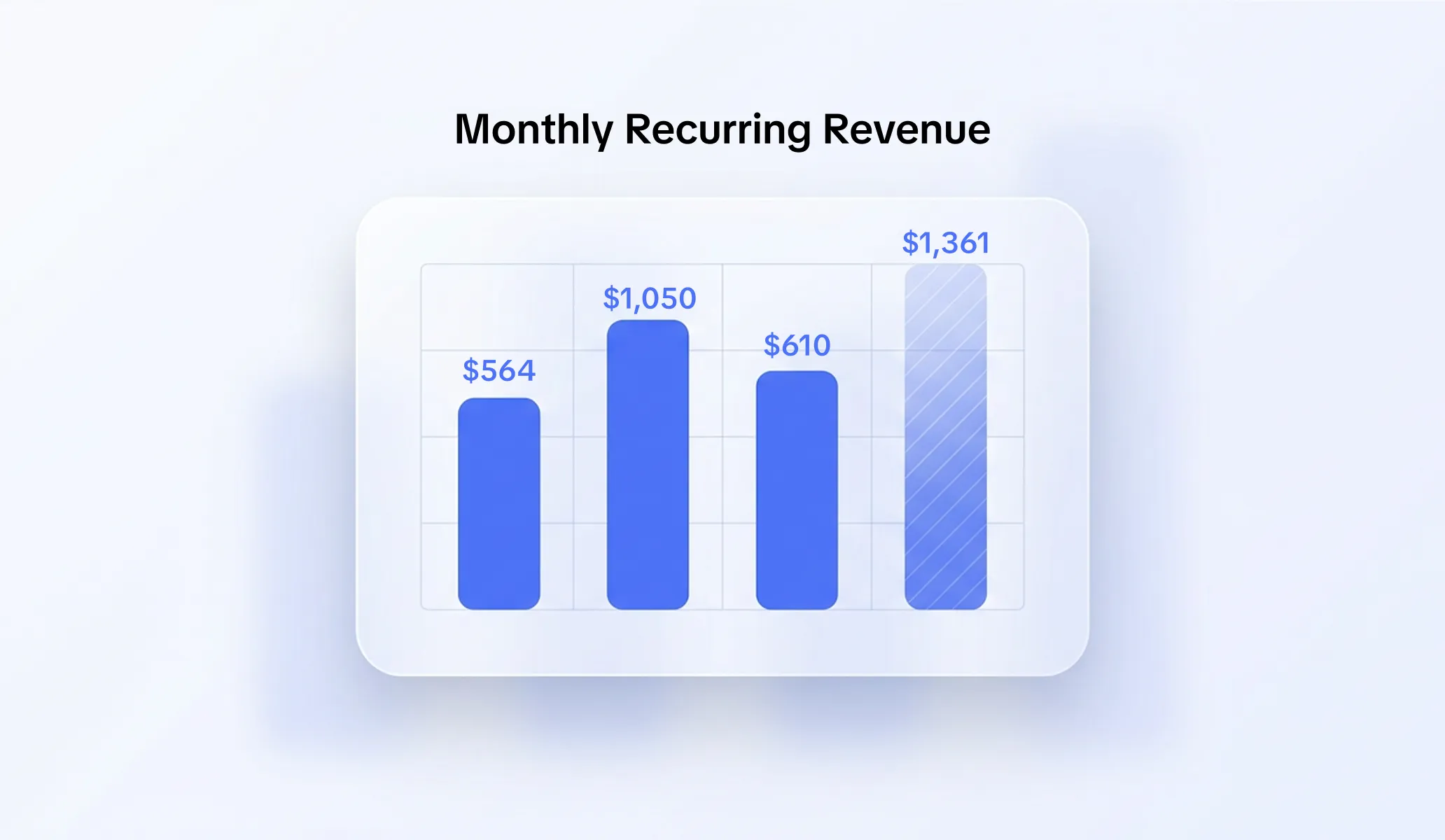
Learn the meaning of MRR (monthly recurring revenue), how to calculate MRR using the MRR formula, and why MRR is important for SaaS companies. Discover how this important metric impacts cash flow per month, subscription business growth, and long-term performance for SaaS companies.
Subtica Team
Mobile App Performance Metrics: Top Metrics, Key KPIs & App Analytics for Mobile App Performance
Discover the most important mobile app metrics to track app performance, user engagement, and engagement and retention. Learn how mobile app analytics metrics, KPIs, and app analytics tools help optimize mobile app performance and drive growth.
Subtica Team

Revenue Management Software: Best Revenue Management Software to Streamline Revenue and Simplify Revenue Management
Learn how revenue management software and modern RMS platforms help subscription apps automate revenue operations, improve forecasting accuracy, and optimize recurring revenue with analytics and AI.
Subtica Team