
Cohort Analysis for Subscription Apps: From Data to Actionable Growth
Explore actionable guides on cohort analysis, retention strategies, and revenue optimization for modern mobile and web subscription products.
 Subtica Team
8 min read

In subscription apps, acquisition is the easy part – anyone can buy installs. The real challenge begins after users enter your product: Do they finish onboarding? Do they hit the paywall? Do they stay subscribed beyond the first billing cycle?
Most analytics tools only show baseline metrics – funnels, retention curves, top-line revenue. Useful, but shallow. They don’t reveal how different user groups behave over time or how your changes to pricing, onboarding, or acquisition channels actually influence retention and renewals. You see outcomes, but not the levers behind them.
That’s where cohort analysis turns into a true growth engine – not another reporting widget, but a framework for making confident product and revenue decisions. In this guide, we’ll show how to use cohort analysis to understand retention patterns, uncover churn drivers, and build a subscription app that scales predictably. No theory for theory’s sake – just actionable steps, real examples, and insights built for recurring-revenue products.
What Is Cohort Analysis?
Cohort analysis is a method to understand how your subscribers behave over time by grouping them into meaningful segments. A cohort is simply a set of users who share a common starting point or action – for example, signed up in February, completed onboarding last week, or converted to a paid subscription after a trial.
Unlike static metrics or aggregated dashboards, cohort analysis tracks behavior trends over time: who stays engaged, who cancels, and, most importantly, what drives these outcomes. It provides a clear, actionable view of retention, churn, and lifetime value across your subscribers.
There are two main types of cohorts teams rely on:
Acquisition cohorts are grouped by when users first entered your app – install, signup, or subscription date. This type is ideal for tracking retention, revenue, and churn patterns over time. For example, you can compare subscribers acquired in January versus those from a March campaign to see which channels deliver the most loyal users.
Behavioral cohorts are grouped by what users do inside your app – completing onboarding, reaching a paywall, using a key feature, or pausing a subscription. These cohorts reveal why users churn or stick, helping you identify friction points and optimize your subscription funnels.
A simple cohort example: imagine 200 users signed up in September. After one month, only 40 are still active – a 20% retention rate. Break it down by acquisition channel:
- Users from Campaign 1 (e.g., Meta) retain at 50%
- Users from Campaign 2 (e.g., Google) retain at just 10%
Same cohort size, but drastically different outcomes. Cohort analysis turns a mediocre retention rate into actionable insight: now you can see which acquisition channels are driving long-term subscribers – and which are wasting your budget.
This is the power of cohort analysis: it transforms raw subscription data into growth decisions, helping you optimize product experience, marketing campaigns, and revenue strategies.
Why Cohort Analysis Matters for Subscription Apps?
In subscription apps, growth doesn’t come from installs – it comes from retention. That’s where cohort analysis becomes a game-changer. Instead of relying on aggregate metrics or vanity dashboards, it reveals how product changes, pricing experiments, and marketing campaigns truly influence user behavior over time. You see what drives engagement, revenue, and loyalty – and what only looks good on paper.
Cohort analysis is critical for optimizing the entire subscription funnel. It shows which onboarding flows deliver lasting retention, which acquisition channels attract high-LTV subscribers, and how different subscription models – monthly, quarterly, annual, or trial-based – impact churn. Promotions, feature launches, pricing tests, and cancellation flows can all be evaluated with precision, giving you actionable insights to turn experiments into sustainable growth.
This isn’t just a nice-to-have metric – it’s a strategic tool. Whether you’re running A/B tests, launching new campaigns, or seeking to reduce churn, cohort analysis equips you with the insights to make confident, data-driven decisions. For subscription apps, it turns guesswork into strategy, short-term installs into long-term retention, and raw metrics into predictable, compounding revenue.
How Cohort Analysis Works in Subtica
Understanding cohort behavior is one thing – seeing it in action is where the real insight lies. With Subtica, you don’t just track retention as a number; you break it down by period, country, and subscription type, uncovering exactly who sticks, who churns, and why. Each cohort becomes a story of engagement and revenue, not just a line in a dashboard.
Example: Cohort Table in Subtica BI
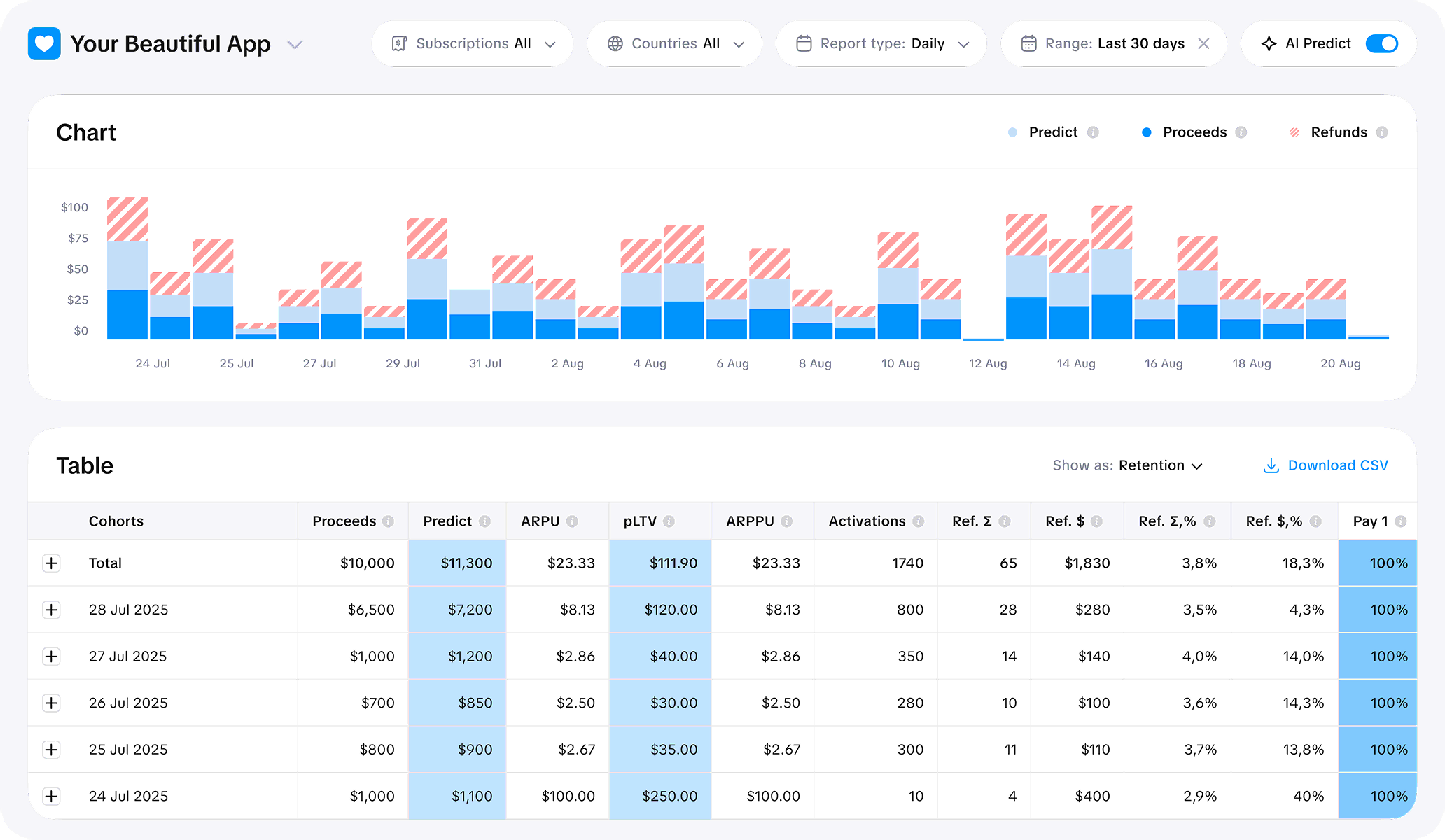
In this table, the first column shows the cohort – for example, users who signed up in October. Expanding a cohort reveals subscription types, so you can instantly see how monthly, quarterly, or annual plans perform differently.
Across the table, key metrics are displayed for each cohort and subscription type:
- Proceeds – total revenue generated by the cohort
- ARPU – average revenue per user
- ARPPU – average revenue per paying user
- Activations – how many users actually started using the subscription
- Refunds – track cancellations and refunds
- Pay1, Pay2… – track sequential payments to understand retention over time
By following a row across these metrics, you can watch a cohort’s journey: how many users stick around after the first payment, how revenue grows or declines, and which subscription types drive the most value. Comparing cohorts across periods, countries, or subscription plans uncovers patterns that help you optimize onboarding, pricing, and retention strategies.
Ready to see your own subscription cohorts live? Start tracking with Subtica today.
7 Common Mistakes in Cohort Analysis
Cohort analysis is one of the most powerful tools for subscription apps – but it’s easy to misinterpret the data if you’re not careful. Avoid these common pitfalls to turn your cohort retention analysis into real, actionable insights.
1. Tracking without a clear question
Pulling up a cohort chart “just to see what’s happening” often leads to vanity metrics. Always start with a hypothesis: Did your new onboarding flow improve trial-to-paid conversion? Did TikTok ads bring stickier users than Meta? Cohort analysis works best when it’s tied to a decision or goal.
2. Messy attribution
If your cohort analysis software or event tracking is inconsistent, your cohorts won’t reveal the truth. Make sure installs, signups, conversions, and cancellations are tracked cleanly across all platforms.
3. Wrong cohort size
Too small → noisy results; too large → patterns get lost. Match cohort granularity to your objective: weekly cohorts for onboarding or pricing tests, monthly cohorts for subscription lifecycle analysis. Proper cohort sizing ensures reliable retention insights.
4. Picking the wrong time buckets
Timeframes should match your product’s cadence: daily for high-frequency apps, weekly for moderate engagement, monthly for subscription cycles. Choosing the wrong bucket can hide key trends in your retention cohort analysis.
5. Focusing only on averages
Average retention can be misleading. Don’t stop there – compare cohorts by acquisition channel, campaign, subscription type, or user behavior. Advanced cohort analysis reveals the differences that drive growth and churn.
6. Overreacting to a single insight
One sharp drop doesn’t require a full funnel rebuild. Form a hypothesis, run controlled tests, and validate. Small, measured iterations beat reactive overhauls.
7. Treating cohort analysis as a one-off
Cohorts are a continuous feedback loop. Every onboarding tweak, pricing change, or marketing experiment should be evaluated over time to measure impact on retention and LTV. Cohort analysis customer retention insights are most valuable when updated regularly.
Wrap-up: Make cohort analysis your growth engine
Cohort analysis turns raw subscription data into actionable decisions. With consistent tracking, you can see which experiments improve retention, which campaigns deliver high LTV, and which subscription types or features create loyal users.
For subscription apps, cohort analysis retention isn’t optional – it’s essential. The more you use it, the less you guess and the more you grow. Whether through cohort analysis tools or SaaS cohort analysis software, the key is to embed cohort thinking into every product, marketing, and monetization decision.
Conclusion
With Subtica, cohort analysis is simple, visual, and tailored for mobile and web subscriptions. See retention, revenue, refunds, and engagement broken down by subscription type, country, or acquisition channel – all in one place. Stop guessing which experiments work and start making decisions that drive real, predictable growth.
Subscribe: App Growth Advice
Enjoyed this post? Subscribe to Sub Club for biweekly app growth insights, best practice guides, case studies, and more.

You Might Also like
Why Revenue Forecasting is Essential for Subscription App Growth
See how Subtica’s revenue forecasting helps subscription apps forecast revenue, LTV, and subscriber trends, so your team can act confidently today.

How to Use ARPU to Boost Revenue in Subscription Apps
Discover how Average Revenue Per User (ARPU) helps subscription apps optimize pricing, product mix, and revenue growth. Learn practical strategies for SaaS teams.

Mobile App Analytics: How to Measure What Really Drives Growth
Learn how mobile app analytics helps track key metrics, predict LTV, reduce churn, and forecast revenue. A practical guide for subscription apps and SaaS teams.
Your Data Knows Your Future
Discover how Subtica’s AI turns your subscription data into growth predictions.