
Why Revenue Forecasting is Essential for Subscription App Growth
 Subtica Team
7 min read
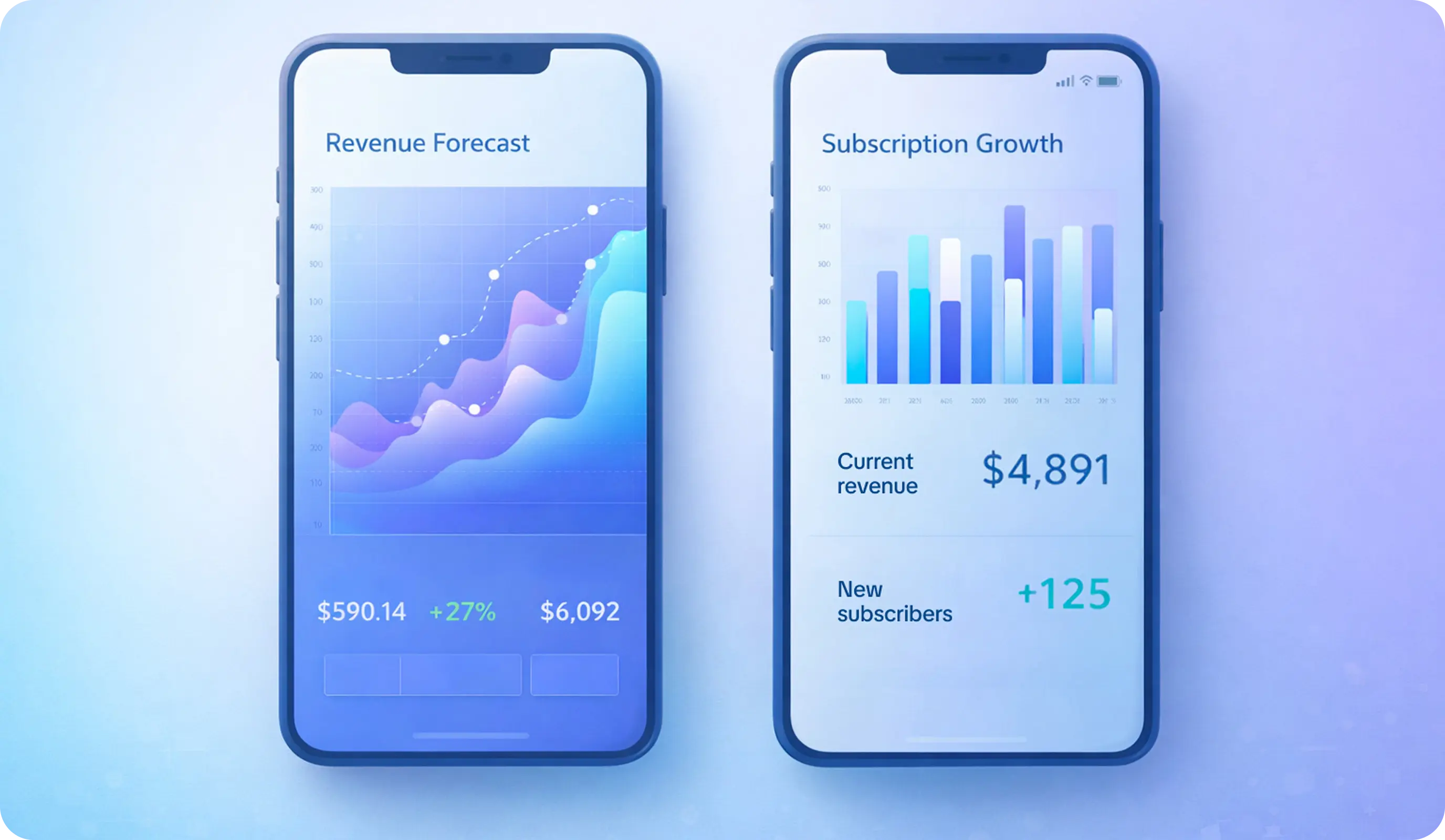
For modern mobile businesses, revenue forecasting is the foundation of sustainable, predictable growth. While traditional analytics focuses on reporting what already happened, revenue forecasting looks ahead, helping teams understand how much revenue their app is likely to generate, when it will happen, and which cohorts will drive it.
Instead of reacting to revenue changes after the fact, product and marketing teams can plan proactively using forward-looking data. This approach is especially critical for subscription apps. When revenue forecasting signals a potential cash-flow gap months in advance, teams gain time to act early: refine subscription strategies, prioritize cohorts with higher predicted value, or optimize plans with stronger long-term performance.
In this article, we’ll explore how revenue forecasting works for mobile apps, why cohort-based prediction is essential for subscription products, and how Predict Revenue and Predict LTV help teams move from static historical reports to confident, forward-looking revenue decisions.
What is Revenue Forecasting?
Revenue forecasting uses historical subscription and transaction data to estimate future revenue outcomes. For mobile apps, this means:
- Using past user activity to forecast future engagement, retention, and subscriber behavior.
- Using past subscription payments to forecast Predict Revenue – the expected net revenue for each cohort.
- Using past user contributions to forecast Predict LTV – the expected net value per activated subscriber.
In other words, revenue forecasting transforms raw historical data into actionable insights for growth and planning, helping teams understand how much revenue is likely to come in, which cohorts are most valuable, and which users drive long-term subscription growth.
Past Analytics vs Revenue Forecasting
Traditional app analytics and revenue forecasting solve different problems.
Past analytics focuses on understanding what has already happened in your app. It answers questions like how much revenue was generated last month, which subscription plan performed best, or where churn increased. These insights are essential for reporting, performance reviews, and understanding historical trends.
Revenue forecasting shifts the focus forward. Instead of describing past outcomes, it uses historical subscription and transaction data to estimate what is likely to happen next. Forecasting helps teams understand how much revenue they can expect in the coming weeks or months, which cohorts will drive that revenue, and where potential risks or growth opportunities may appear.
The key difference lies in decision timing. Past analytics often leads to reactive decisions made after revenue changes have already occurred. Revenue forecasting enables proactive planning, allowing teams to adjust pricing, retention strategies, and product priorities before revenue volatility impacts the business.
In practice, revenue forecasting does not replace historical analytics. It builds on top of it. By turning descriptive metrics into forward-looking signals, forecasting helps subscription apps move from monitoring performance to actively shaping future revenue outcomes.
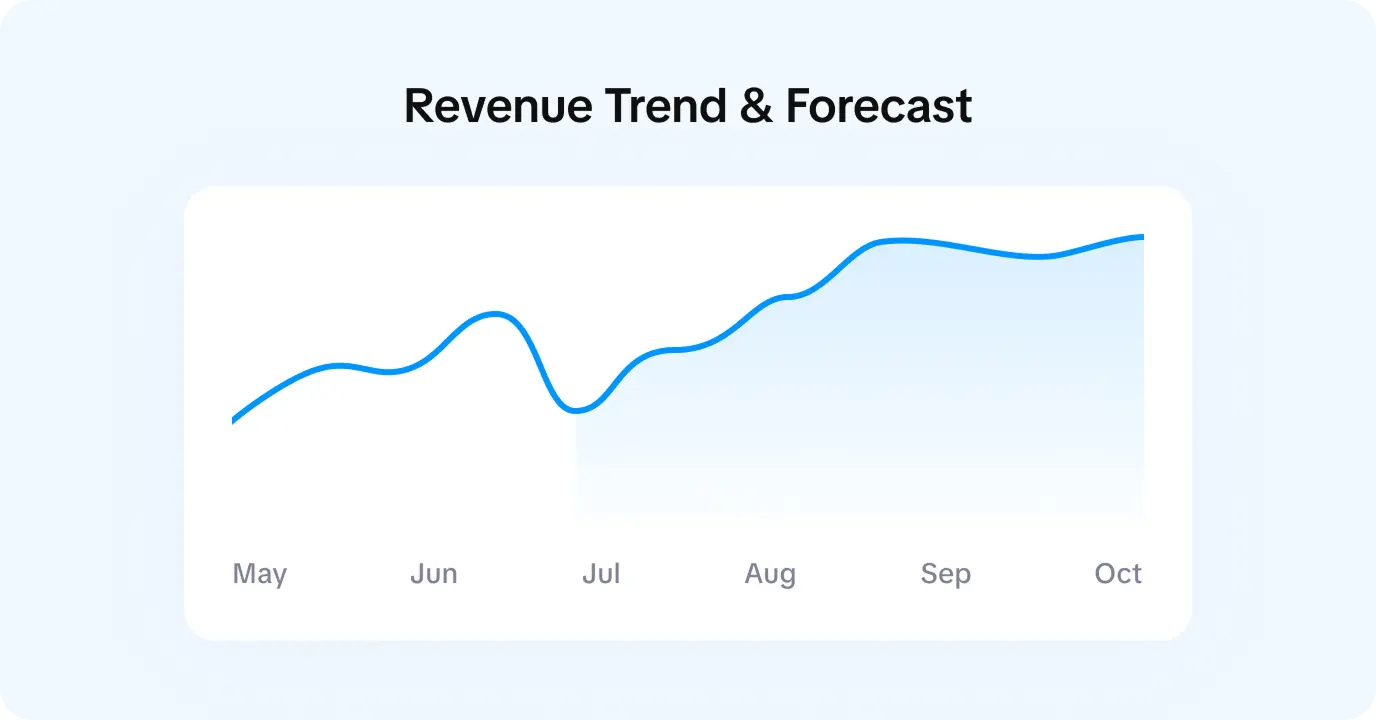
How Revenue Forecasting Works for Subscription Apps?
1. Forecasting user value
Applying revenue forecasting to user data helps teams identify their most valuable subscriber segments. It reveals which users are likely to generate the highest LTV and which cohorts face an increased risk of churn.
With these insights, product and growth teams can refine retention strategies, plan feature releases, and tailor experiences for the cohorts that matter most – ensuring that high-value users stay engaged and continue generating revenue.
2. Forecasting product performance
Revenue forecasting can also be applied to in-app products and subscription plans. By analyzing historical transaction data, you can estimate future Predict Revenue for each product or plan.
This helps you spot high-potential products and identify offerings that may underperform, giving you the chance to optimize pricing, marketing campaigns, or in-app promotions before issues arise.

For example
If a subscription plan shows lower predicted revenue, you can test adjustments such as A/B pricing, promotional offers, or targeted engagement campaigns to improve performance.
3. Forecasting overall revenue
Revenue forecasting aggregates insights from user and product data to project overall cash flow and revenue trends.
If the forecast signals potential cash-flow gaps, teams gain time to take proactive measures – such as prioritizing high-value cohorts, boosting in-app offers, or optimizing subscription plans – to stabilize revenue and maximize long-term growth.
By combining Predict Revenue & LTV, mobile businesses can plan ahead with confidence, moving from reactive reporting to data-driven revenue decisions.
How to Use Revenue Forecasting in Your App with Subtica?
The easiest way to start revenue forecasting for your mobile app is by using Subtica – a platform built specifically for subscription apps, with Predict Revenue and Predict LTV integrated directly into the dashboard. With Subtica, teams move beyond static historical reports and gain forward-looking insights that support decisions around retention, pricing, and product strategy.
How Subtica Generates Predictions?
Subtica uses historical subscription and transaction data to train predictive models based on real user behavior. Once your app is connected, the platform continuously learns from incoming transactional data, improving forecast accuracy over time.
By combining machine learning with cohort-based and geographic analysis, Subtica produces predictions that reflect how different user segments behave, pay, churn, and contribute to revenue across their lifecycle and across markets.
What Subtica Can Predict for Your App?
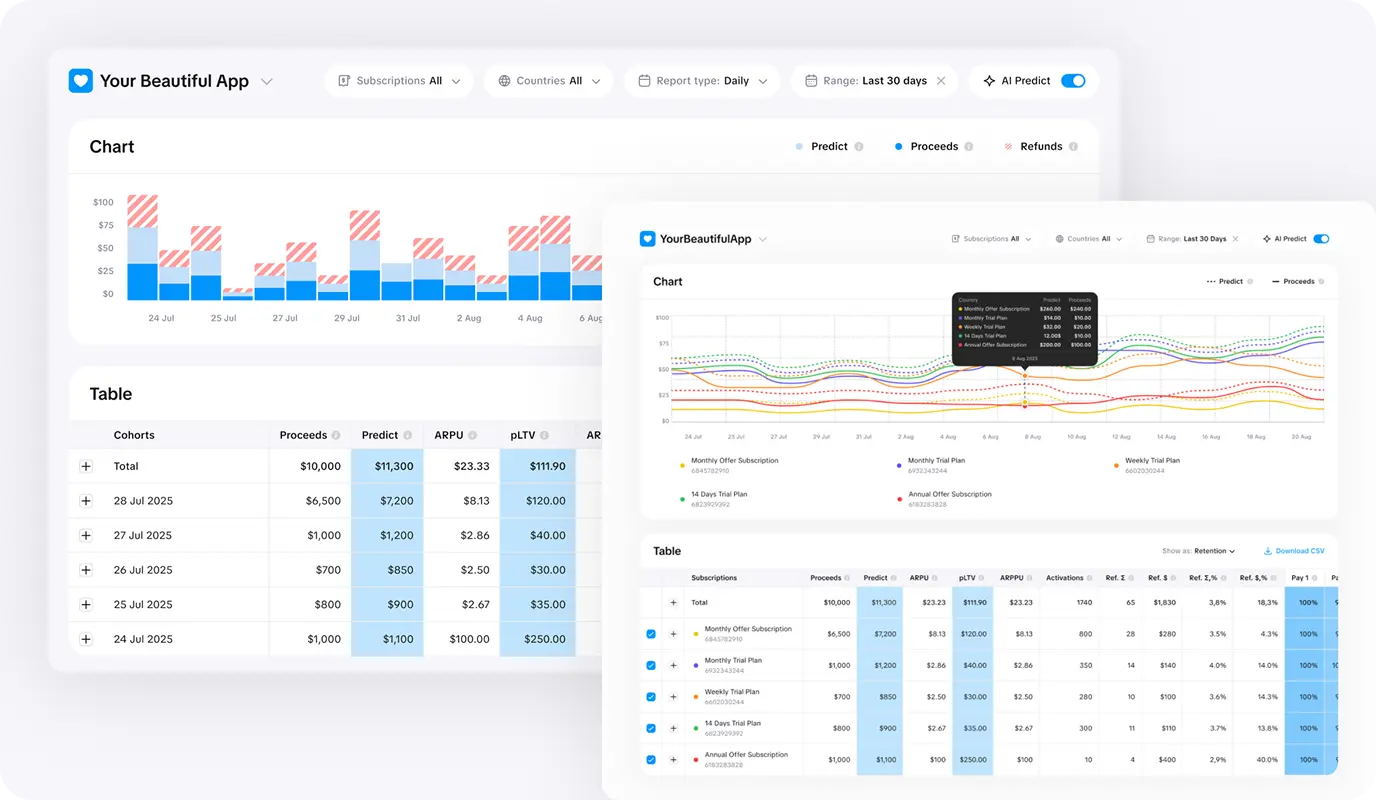
1. Predict LTV per cohort
Subtica estimates the expected net value of activated subscribers at the cohort level. This helps teams identify which acquisition channels, regions, or subscription types drive the highest long-term value, and which cohorts may require retention-focused interventions.
2. Predict Revenue per subscription
Subtica forecasts future net revenue for each subscription plan or cohort. This allows teams to compare plans based on projected performance, not just past revenue, and adjust pricing, promotions, or paywall strategies before revenue trends decline.
3. Predict Revenue and LTV by country
Subtica provides country-level revenue and LTV forecasts, helping teams understand how different markets are expected to perform over time. This makes it easier to prioritize regions with stronger growth potential, adapt pricing to local purchasing power, and plan localization or market expansion strategies with confidence.
4. Product performance and growth opportunities
By aggregating cohort and country-level forecasts, Subtica highlights which subscription tiers or products are likely to contribute most to future revenue. Teams can use these insights to prioritize roadmap decisions, marketing spend, or in-app experiments.
Example: Using Revenue Forecasting in Practice
Imagine a subscription app that offers monthly and annual plans across multiple countries. Historical reports show that monthly subscriptions generate more revenue today in most markets. However, Subtica’s Predict Revenue reveals that users in certain countries who choose annual plans have a significantly higher predicted lifetime value and lower churn.
With this insight, the team can:
- Promote annual plans more aggressively in high-LTV countries
- Localize pricing and paywalls based on predicted country-level performance
- Shift marketing budgets toward regions and cohorts with higher forecasted returns
Instead of reacting to revenue changes after they occur, teams can act early based on predicted outcomes.
Key Considerations When Using Revenue Forecasting
Revenue forecasting provides powerful forward-looking insights, but no predictive model can capture every factor. External influences such as competitor actions, sudden market shifts or changes in regulations can affect outcomes in ways that forecasts alone cannot predict.
For the most reliable planning, combine Subtica’s forecasts with market research, user feedback, and competitive analysis. This holistic approach ensures that your strategy accounts for both predicted trends and real-world variables.
Data quality also plays a crucial role. The more accurate and complete your subscription and transaction data, the better Subtica can generate Predict Revenue and Predict LTV, making your revenue forecasts more precise and actionable.
Wrapping Up
If your app has been live for a while and you have historical subscription and transaction data, integrating revenue forecasting into your analytics workflow can unlock powerful insights. Subtica helps you understand future user behavior and cohort performance, enabling smarter product decisions and more effective growth strategies
For apps that are just starting to track revenue, adding a platform like Subtica is the fastest way to begin. Subtica can generate Predict Revenue and Predict LTV forecasts quickly, giving teams actionable insights from day one. As more data flows in, the accuracy of these predictions improves, allowing your forecasts to become increasingly precise over time.
Remember that while revenue forecasting provides a clear view of expected outcomes, combining it with market research, user feedback, and competitor analysis ensures that your planning captures both predicted trends and real-world variables. This approach helps teams make confident, proactive decisions to drive sustainable growth.
Subscribe: App Growth Advice
Enjoyed this post? Subscribe to Sub Club for biweekly app growth insights, best practice guides, case studies, and more.

You Might Also like

How to Use ARPU to Boost Revenue in Subscription Apps
Discover how Average Revenue Per User (ARPU) helps subscription apps optimize pricing, product mix, and revenue growth. Learn practical strategies for SaaS teams.

Mobile App Analytics: How to Measure What Really Drives Growth
Learn how mobile app analytics helps track key metrics, predict LTV, reduce churn, and forecast revenue. A practical guide for subscription apps and SaaS teams.

Grow Revenue With Predictive Customer Lifetime Value Analytics
Step-by-step guide to calculating Customer Lifetime Value (LTV) for subscription apps. Boost retention, optimize revenue, and forecast long-term growth for your mobile apps.
Your Data Knows Your Future
Discover how Subtica’s AI turns your subscription data into growth predictions.