
 Subtica Team
12 min read
LTV (Lifetime Value): How to Calculate Customer Lifetime Value for Subscription Apps and Maximize Customer Value
LTV is essentially a measure of the long-term value a subscriber brings to your business throughout their relationship with your app. It helps you understand how much revenue a customer generates beyond the initial purchase and whether your marketing spend and user acquisition campaign are sustainable. For subscription apps, being able to calculate lifetime value accurately allows you to allocate budget efficiently, optimize retention rates, and make informed decisions about growth.

What Is LTV (Lifetime Value) in Subscription Apps?
LTV estimates the total revenue a customer brings to your business while the customer stays active. It reflects factors like subscription price, in-app purchases, user engagement, and customer churn. For iOS subscription apps, overall LTV shows the true value of your user base and highlights how much value each group of users creates over time.
Why LTV Is a Critical Metric for SaaS Business and iOS Subscription Apps
LTV helps set the foundation for growth because it connects acquisition, retention, and revenue. It shows how much to spend on acquiring new subscribers and how to keep customers engaged. By analyzing user behavior and customer behavior across your customer base, you gain actionable insight into which acquisition source and which segment delivers much value.
How to Calculate Customer Lifetime Value (LTV)
To calculate customer lifetime value, you need to combine retention rates, average revenue per user, and churn. LTV calculations typically multiply ARPU by average customer lifetime. Advanced models incorporate predicted LTV using cohort data and behavioral signals to estimate long-term value more accurately.
Core Metrics Required to Calculate LTV (ARPU, Churn, Customer Acquisition Cost)
You must measure average revenue per user, customer churn, retention rates, and customer acquisition cost. These data points help you understand how much revenue a customer generates and how much you are spending to acquire them. Without accurate CAC and churn data, LTV estimates may be misleading.
Lifetime Value Formula for Subscription Apps
The standard lifetime value formula is:
LTV = Average Revenue per User × Average Customer Lifetime.
In subscription apps, average lifetime is often calculated as 1 ÷ churn rate. This formula helps you understand the much revenue expected from each subscriber during their active period.
Simple LTV Calculation for SaaS Business
A simple SaaS LTV calculation multiplies ARPU by the average number of months a customer stays subscribed. This approach is useful for early-stage businesses that need quick insight without complex prediction models.
Advanced LTV Calculations with Prediction Models
Advanced LTV calculations incorporate predicted LTV by analyzing user engagement, acquisition source, external factors, and cohort retention curves. These models provide more accurate estimates of overall LTV and support setting realistic goals for scaling.
LTV Formula Explained: From Basic Calculation to SaaS Forecasting
The lifetime value formula helps you understand how much revenue a customer brings to your business throughout their relationship with your product. LTV is essentially a way to calculate lifetime revenue based on retention rates and average revenue per user.
For subscription apps and SaaS business models, being able to calculate lifetime value accurately allows you to estimate long-term value, optimize marketing spend, and allocate resources more effectively. Basic LTV calculations provide a quick snapshot, while advanced models incorporate predicted LTV and multiple data points to support revenue forecasting and strategic planning.
The standard SaaS formula for LTV is:
LTV = Average Revenue per User (ARPU) ÷ Customer Churn Rate
This formula works because churn determines how long a customer stays subscribed. If retention rates are strong and customer churn is low, overall LTV increases significantly.
For example, if your average revenue per user is $20 per month and your monthly churn rate is 5%, you are able to calculate lifetime as:
20 ÷ 0.05 = $400 LTV
This means each subscriber generates approximately $400 in revenue throughout their relationship. This calculation helps you understand how much to spend on acquiring users and whether your customer acquisition cost is sustainable.
Cohort-Based LTV Calculation for Subscription Apps
Cohort-based LTV calculations analyze a specific group of users based on acquisition source, subscription start date, or user acquisition campaign. Instead of averaging the entire customer base, this method examines user behavior and retention patterns within each segment.
By segmenting users into cohorts, you can measure how much revenue each group of users generates, identify differences in customer behavior, and determine which acquisition channels deliver much value. This approach provides more actionable insight than simple averages and helps you optimize spending to acquire higher-value subscribers.
Predictive LTV Calculation Using Revenue Forecasting
Predictive LTV uses early retention signals, user engagement metrics, and other behavioral data points to estimate future revenue before the full customer lifetime is realized. Predicted LTV is especially useful for subscription apps that need faster insight into performance.
By incorporating factors like subscription price, in-app purchases, customer churn trends, and external factors affecting your vertical, predictive models estimate the true value of new users shortly after acquisition. This allows you to make informed decisions, adjust marketing spend quickly, and scale campaigns that generate strong long-term value.
LTV, CAC, and Customer Acquisition Cost: Understanding the Relationship
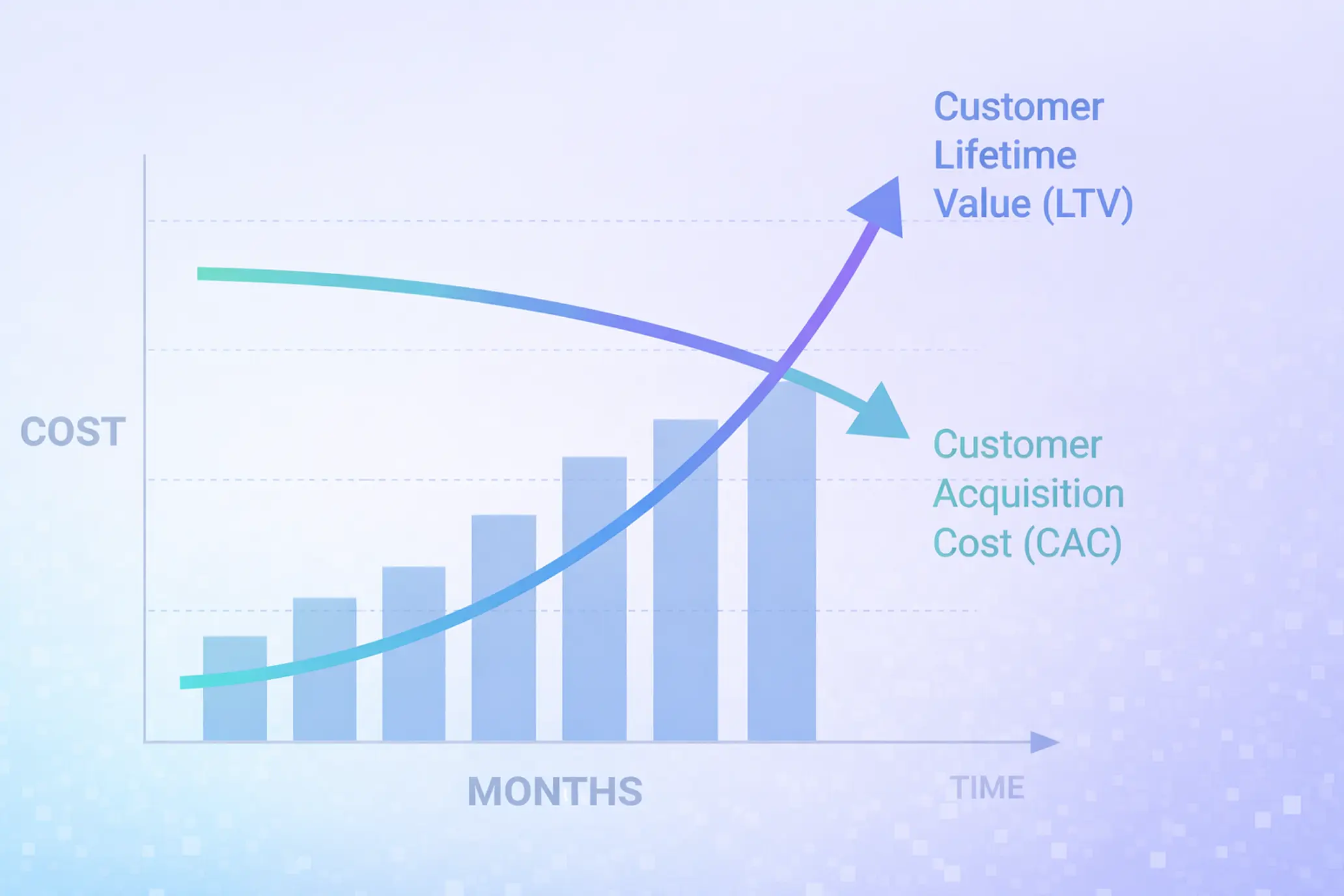
LTV and customer acquisition cost (CAC) must always be analyzed together. While LTV estimates how much revenue a customer brings to your business throughout their relationship, CAC shows how much you are spending to acquire each subscriber.
Using LTV alongside CAC helps you understand whether your marketing spend is sustainable and how much to allocate to future user acquisition campaigns. If you are not measuring both metrics, you risk scaling a customer base that generates less long-term value than what you are spending to acquire it. For subscription apps, this relationship directly impacts profitability and growth strategy.
LTV to CAC Ratio for Subscription Business
The LTV:CAC ratio measures how much value a customer brings compared to the cost of acquiring them. It is calculated by dividing overall LTV by customer acquisition cost.
For example, if your LTV is $400 and your CAC is $100, your ratio is 4:1. This means each paying customer generates four times the revenue compared to what you are spending to acquire them.
This ratio provides actionable insight into how much to spend on scaling. It helps you understand whether your user acquisition campaign is efficient and whether you can increase marketing spend without reducing long-term value.
How CAC Impacts Customer Lifetime Value
While CAC does not directly change LTV calculations, it strongly influences how you interpret LTV. If customer acquisition cost is too high relative to predicted LTV, your business model may not be sustainable.
High CAC forces you to reconsider subscription price, improve retention rates, or reduce customer churn to increase overall LTV. By optimizing user behavior, customer behavior, and onboarding flows, you can increase how much revenue each subscriber generates throughout their relationship and improve the balance between spending to acquire and revenue generated.
Benchmark LTV:CAC Ratio for SaaS Business
In SaaS business models, a commonly accepted benchmark LTV:CAC ratio is 3:1 or higher. This indicates that the long-term value of each customer significantly exceeds the cost of acquisition.
However, benchmarks vary depending on vertical, subscription apps category, and external factors such as competition and pricing models. Monitoring your LTV:CAC ratio over time helps in setting realistic goals, managing marketing spend, and making informed decisions about scaling your customer base while maintaining healthy unit economics.
Churn and Lifetime Value: How Retention Impacts LTV
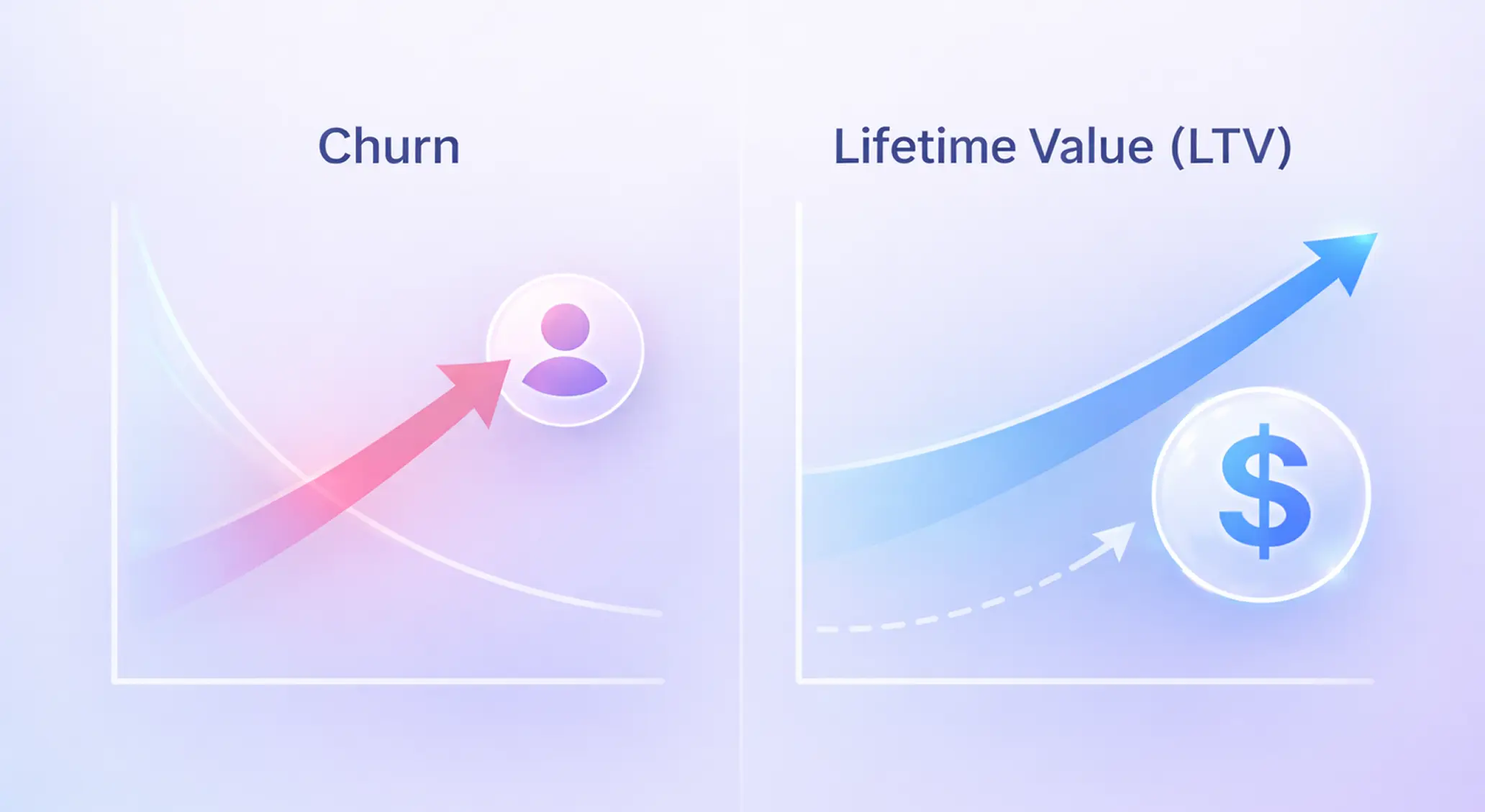
Customer churn has a direct impact on lifetime value because it determines how long a customer stays active. Since LTV is essentially based on retention rates and average revenue per user, even small improvements in retention can significantly increase overall LTV.
For subscription apps, understanding how customer churn affects your customer base provides actionable insight into long-term value. If subscribers cancel early, the revenue a customer generates throughout their relationship declines. Strong retention, on the other hand, increases how much value each subscriber brings to your business and improves predicted LTV accuracy.
How Churn Affects LTV Calculations
Many LTV calculations rely directly on churn rate. In the standard SaaS formula, lifetime is calculated as 1 ÷ churn rate. This means that if churn increases, the estimated time a customer stays decreases — reducing lifetime value.
For example, if churn rises due to poor user engagement or weak onboarding, your ability to calculate lifetime accurately is compromised, and overall LTV declines. Monitoring customer behavior, analyzing data points like in-app activity and subscription renewal patterns, and understanding external factors affecting your vertical help you identify why churn is increasing.
Because churn influences predicted LTV, even small percentage changes can dramatically shift how much revenue you expect from a group of users.
Reducing Churn to Increase Customer Lifetime Value
Reducing customer churn is one of the most effective ways to increase customer lifetime value. Improving user engagement, strengthening onboarding, optimizing subscription price positioning, and enhancing customer support all help keep customers engaged.
By segmenting users based on acquisition source and user behavior, you can identify which subscribers are most likely to cancel and intervene early. When customers stay longer, they generate much revenue over time, increasing overall LTV without necessarily increasing marketing spend.
Retention improvements also make it safer to allocate more budget toward spending to acquire new users, since the long-term value of each subscriber becomes more predictable.
Subscription Duration and Its Impact on Lifetime Value
Subscription duration directly influences how much revenue a customer generates. The longer a subscriber remains active, the greater the long-term value.
Monthly and annual plans may produce different LTV outcomes depending on retention rates and renewal patterns. Annual subscribers often reduce short-term churn risk, while monthly subscribers may require stronger engagement strategies.
Understanding how subscription duration affects lifetime value helps you make informed decisions about pricing structure, promotional offers, and user acquisition campaigns. By analyzing how long customers stay and how much revenue they generate beyond the initial payment, you gain clarity on the true value of your subscription model.
LTV Benchmarks for Subscription Apps and SaaS Business
LTV benchmarks help you understand how much value your customer base generates compared to similar companies in your vertical. Because LTV estimates the long-term value of a subscriber, comparing your overall LTV against industry standards provides actionable insight into performance gaps.
Benchmarks vary depending on factors like subscription price, retention rates, customer churn, acquisition source, and user behavior. For SaaS business and subscription apps, understanding how much revenue a customer brings to your business — and how that compares to peers — helps you make informed decisions about marketing spend, spending to acquire users, and setting realistic goals.
Key factors that influence benchmark comparisons:
- Retention rates and customer churn
- Average revenue per user (ARPU)
- Subscription price and in-app monetization
- Customer acquisition cost (CAC)
- User engagement and customer behavior
- External factors within your vertical
12-Month LTV Benchmarks by Subscription Category (Table)
Below is an illustrative benchmark table showing how much revenue a customer typically generates over 12 months in different subscription app categories. Actual numbers vary by region and acquisition source, but these ranges provide directional insight.
| Subscription Category | Avg Monthly ARPU | Avg Annual Churn | 12-Month LTV Estimate | Notes |
|---|---|---|---|---|
| Productivity Apps | $15–$25 | 35–50% | $120–$220 | Strong retention increases overall LTV |
| Health & Fitness | $20–$35 | 40–60% | $140–$260 | Seasonal churn impacts predicted LTV |
| Finance Apps | $25–$50 | 25–40% | $250–$500 | Higher ARPU, stronger long-term value |
| Streaming / Content | $10–$20 | 45–65% | $90–$180 | User engagement heavily affects churn |
| B2B SaaS Business | $50–$150 | 15–30% | $600–$1,800 | High customer stays duration |
These benchmarks help you understand how much value a typical subscriber generates within the first year. If your LTV is significantly below category norms, it may signal issues with retention rates, subscription price positioning, or customer support quality.
LTV Benchmarks by Subscription Duration (Monthly vs Annual)
Subscription duration directly affects how long a customer stays and how much revenue they generate throughout their relationship.
Monthly Subscription Model
- Lower upfront commitment
- Higher customer churn risk
- Faster feedback for predicted LTV models
- Requires strong user engagement to maintain overall LTV
Annual Subscription Model
- Higher upfront revenue
- Reduced short-term churn
- More predictable revenue per customer
- Stronger long-term value if retention remains high
Annual subscribers often generate higher overall LTV because revenue is recognized earlier and customers are committed for longer periods. However, the true value depends on retention beyond the first billing cycle and renewal behavior.
How to Compare Your LTV Against Industry Benchmark Data
To effectively compare your LTV against benchmarks, follow these steps:
- Segment your user base by acquisition source and user acquisition campaign.
- Calculate lifetime value separately for each group of users.
- Measure average revenue per user and customer churn consistently.
- Compare your LTV:CAC ratio to industry standards.
- Adjust for external factors affecting your vertical.
Using LTV alongside benchmark data helps you understand whether you are generating much value relative to your peers. It also clarifies how much to spend on marketing, how much to allocate toward customer support, and whether your predicted LTV aligns with realized revenue.
Ultimately, benchmarking is not just about comparison — it is about identifying opportunities to increase customer lifetime value, optimize spending to acquire, and strengthen the long-term value of your subscription apps.
Common Mistakes in LTV Calculation
LTV calculations can easily become misleading if assumptions are incorrect or incomplete. Since LTV estimates long-term value based on retention rates and average revenue per user, small errors in inputs can significantly distort overall LTV.
Common mistakes often result in overestimating how much revenue a customer brings to your business, misjudging marketing spend efficiency, or misunderstanding customer behavior. Avoiding these errors is critical for making informed decisions and setting realistic goals.
Overestimating Lifetime in Subscription Apps
One of the most frequent mistakes is assuming a customer stays longer than actual data supports. Many businesses calculate lifetime using early performance data without accounting for future customer churn.
If retention rates decline over time or external factors impact your vertical, predicted LTV may be inflated. This leads to overspending on user acquisition campaigns and allocating more budget than sustainable. Accurate lifetime modeling requires real retention curves, not optimistic assumptions.
Ignoring Churn Variance and Cohort Differences
Not all subscribers behave the same way. Ignoring differences between acquisition source, subscription price tiers, or user engagement levels can distort LTV.
Segmenting users into a specific group of users based on acquisition channel or customer behavior provides more actionable insight. Cohort-based LTV helps you understand how much value different segments of your customer base generate, instead of relying on blended averages that hide performance gaps.
Miscalculating Customer Acquisition Cost in LTV Formula
LTV should always be analyzed alongside customer acquisition cost (CAC). A common error is excluding certain marketing spend, operational costs, or customer support expenses when calculating CAC.
If you underestimate spending to acquire paying customers, your LTV:CAC ratio may appear healthy while actual profitability suffers. Accurate CAC measurement ensures that LTV helps you understand whether your growth strategy is sustainable.
How to Increase Customer Lifetime Value in Subscription Apps
Increasing customer lifetime value requires improving both revenue generation and retention. Since LTV is essentially driven by how long a customer stays and how much revenue they generate throughout their relationship, optimization must focus on engagement, pricing, and churn reduction.
Strategies to increase overall LTV include:
- Improving retention rates
- Increasing average revenue per user
- Optimizing subscription price structure
- Enhancing user engagement and onboarding
- Reducing customer churn
Increase ARPU to Improve Lifetime Value
Increasing average revenue per user directly improves LTV because most formulas multiply ARPU by customer lifetime.
You can increase ARPU by:
- Introducing higher subscription price tiers
- Offering annual plans
- Adding in-app upgrades or premium features
- Upselling to existing paying customers
Even small increases in ARPU can significantly raise long-term value across your entire user base.
Optimize Pricing Strategy in SaaS Business
Subscription price positioning affects both acquisition and retention. If pricing is too high, customer churn may increase. If pricing is too low, you limit much revenue each subscriber generates.
Testing pricing models, analyzing user behavior, and evaluating willingness to pay within your market segment helps you balance growth and profitability. Smart pricing ensures you are able to calculate lifetime value based on stable, scalable revenue assumptions.
Improve Retention to Increase Customer Lifetime Value
Retention rates have a compounding effect on LTV. The longer a customer stays, the more revenue a customer generates beyond the initial payment.
Improving onboarding, strengthening customer support, and increasing user engagement are proven ways to reduce churn. When customers stay longer, predicted LTV becomes more accurate and sustainable, allowing you to allocate more budget toward user acquisition with confidence.
Use Cohort Analysis to Identify High Lifetime Value Segments
Cohort analysis allows you to identify which acquisition source, campaign, or segment delivers much value over time.
By segmenting users based on user acquisition campaign or behavior patterns, you gain insight into which group of users generates the highest overall LTV. This actionable data helps you shift marketing spend toward high-performing channels and reduce spending to acquire low-value subscribers.
Predicted vs Realized LTV: Understanding LTV Prediction Models
LTV might be measured in two ways: predicted and realized. Understanding the difference helps you make informed decisions about scaling and forecasting.
Predicted LTV relies on early data points and behavioral signals, while realized LTV reflects actual revenue generated throughout their relationship. Both perspectives are important for subscription apps operating in dynamic markets.
What Is Predicted Lifetime Value?
Predicted LTV uses early retention rates, user engagement metrics, and other customer behavior indicators to estimate future revenue.
It allows businesses to forecast long-term value shortly after acquisition, rather than waiting months to measure full lifetime performance. Predicted LTV is especially useful for optimizing marketing spend and evaluating new user acquisition campaigns quickly.
When to Use Predictive LTV in Subscription Apps
Predictive LTV should be used when scaling acquisition, launching new campaigns, or entering new markets. It helps you understand early whether a subscriber is likely to generate strong long-term value.
When combined with CAC data, predicted LTV helps determine how much to spend on acquiring users and whether a specific acquisition source is sustainable.
Calculating LTV with Subtica for iOS Subscription Apps
For iOS subscription apps, calculating LTV accurately requires structured analytics across revenue, churn, and acquisition data.
Subtica enables you to calculate lifetime value automatically by combining subscription data, retention metrics, and customer acquisition cost in one system. This allows you to monitor overall LTV and predicted LTV without relying on manual spreadsheets.
Automated LTV Calculation for Subscription Apps
Automated LTV calculations pull real-time data points from subscription events, renewal behavior, and user engagement.
This ensures you are able to calculate lifetime value consistently and measure how much revenue a customer brings to your business throughout their relationship.
Cohort-Based LTV Tracking and Prediction
Subtica supports cohort-based analysis, allowing you to segmenting users by acquisition source, subscription start date, or campaign.
This helps you identify which group of users generates much value, compare retention rates across segments, and improve the accuracy of predicted LTV models.
Revenue, Churn, and CAC Analytics in One Platform
Combining revenue, customer churn, and customer acquisition cost analytics in one platform provides complete visibility into long-term value.
This unified approach helps you understand how much to allocate toward marketing spend, how much value each subscriber generates, and how to balance spending to acquire with sustainable revenue growth.
What Is a Good LTV for a Subscription App?
A good LTV depends on your vertical, subscription price, and customer acquisition cost. In most SaaS business models, overall LTV should significantly exceed CAC to ensure profitable growth.
Rather than focusing on a single number, businesses should evaluate LTV in relation to retention rates, ARPU, and marketing spend efficiency.
How to Define a Healthy Lifetime Value Target
To define a healthy lifetime value target:
- Calculate your current LTV and CAC accurately
- Analyze retention rates and customer churn trends
- Evaluate how much revenue a customer generates beyond the initial period
- Set realistic goals based on benchmark data
- Continuously refine predicted LTV models
A strong LTV target ensures that every subscriber brings sustainable long-term value and supports scalable growth for your subscription apps.
FAQ
Want to Apply These Insights to Your App?
Track subscription metrics, reduce churn, and scale your iOS app revenue with Subtica’s subscription analytics platform.


Related Articles

Subscription Analytics Dashboard for SaaS: Data-Driven Metrics and Revenue Insights for iOS Apps
Subscription analytics helps SaaS and subscription businesses turn data into valuable insight. Learn how subscription analytics software tracks subscription metrics, payments, and performance with customizable dashboards, charts, and one-click reports.
Subtica Team

Subscription Business Metrics to Track: Essential SaaS Metrics for Every Subscription Business
Discover the key subscription metrics every business should monitor. Learn which key metrics SaaS companies and subscription businesses use, the most important metric to track, and how a strong analytics system helps monitor subscription metrics and growth.
Subtica Team

Predictive Analytics Examples, Applications, and Algorithms for Subscription Apps
Predictive analytics helps businesses forecast trends using algorithms and data models. Learn how predictive analytics works, key use cases like fraud detection, and how companies use predictive analytics to forecast future outcomes.
Subtica Team

Predictive Analytics Definition: What Is Predictive Analytics and How It Works
Predictive analytics uses machine learning, data mining, and statistical models to predict future outcomes. Learn the predictive analytics definition and how businesses use predictive analytics with historical data and current data to forecast trends.
Subtica Team

Customer Churn Rate Analysis for SaaS: How to Calculate Churn Rate, Perform a Churn Analysis, and Improve Retention
Learn how to calculate customer churn rate with practical churn analysis techniques. Understand customer churn, revenue churn, and retention metrics while analyzing your churn to improve retention and reduce churn rate.
Subtica Team
ARR Revenue: Annual Recurring Revenue Calculation, Recurring Revenues & How to Calculate ARR for SaaS Business Billing
ARR revenue (annual recurring revenue) is a core metric for subscription and SaaS business models. In this guide to annual recurring revenue, learn how to calculate ARR, understand recurring revenues, and improve revenue growth. Discover ARR calculation methods, why this SaaS metric matters, and how annual recurring revenue supports predictable subscription business performance.
Subtica Team
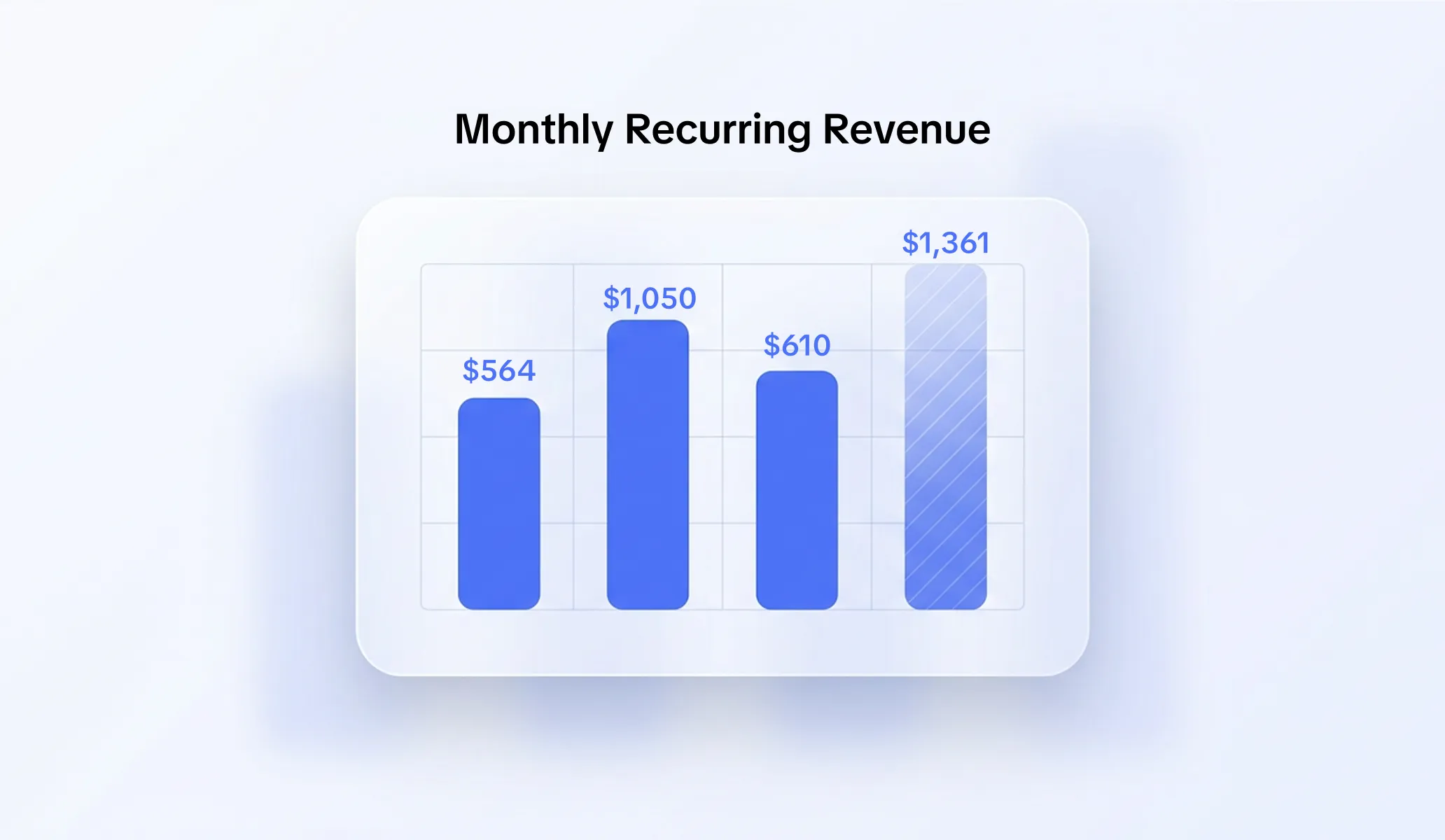
MRR (Monthly Recurring Revenue): How to Calculate MRR and Use MRR to Grow Your Subscription Business
Learn the meaning of MRR (monthly recurring revenue), how to calculate MRR using the MRR formula, and why MRR is important for SaaS companies. Discover how this important metric impacts cash flow per month, subscription business growth, and long-term performance for SaaS companies.
Subtica Team
Mobile App Performance Metrics: Top Metrics, Key KPIs & App Analytics for Mobile App Performance
Discover the most important mobile app metrics to track app performance, user engagement, and engagement and retention. Learn how mobile app analytics metrics, KPIs, and app analytics tools help optimize mobile app performance and drive growth.
Subtica Team

Revenue Management Software: Best Revenue Management Software to Streamline Revenue and Simplify Revenue Management
Learn how revenue management software and modern RMS platforms help subscription apps automate revenue operations, improve forecasting accuracy, and optimize recurring revenue with analytics and AI.
Subtica Team