
 Subtica Team
18 min read
MRR (Monthly Recurring Revenue): How to Calculate MRR and Use MRR to Grow Your Subscription Business
For any subscription business, especially in SaaS and iOS apps, MRR (monthly recurring revenue) is a top-level MRR indicator of predictable growth. Whether you run a SaaS business or a mobile subscription-based business, understanding how to calculate MRR, analyze MRR growth, and improve MRR is critical for long-term revenue growth.
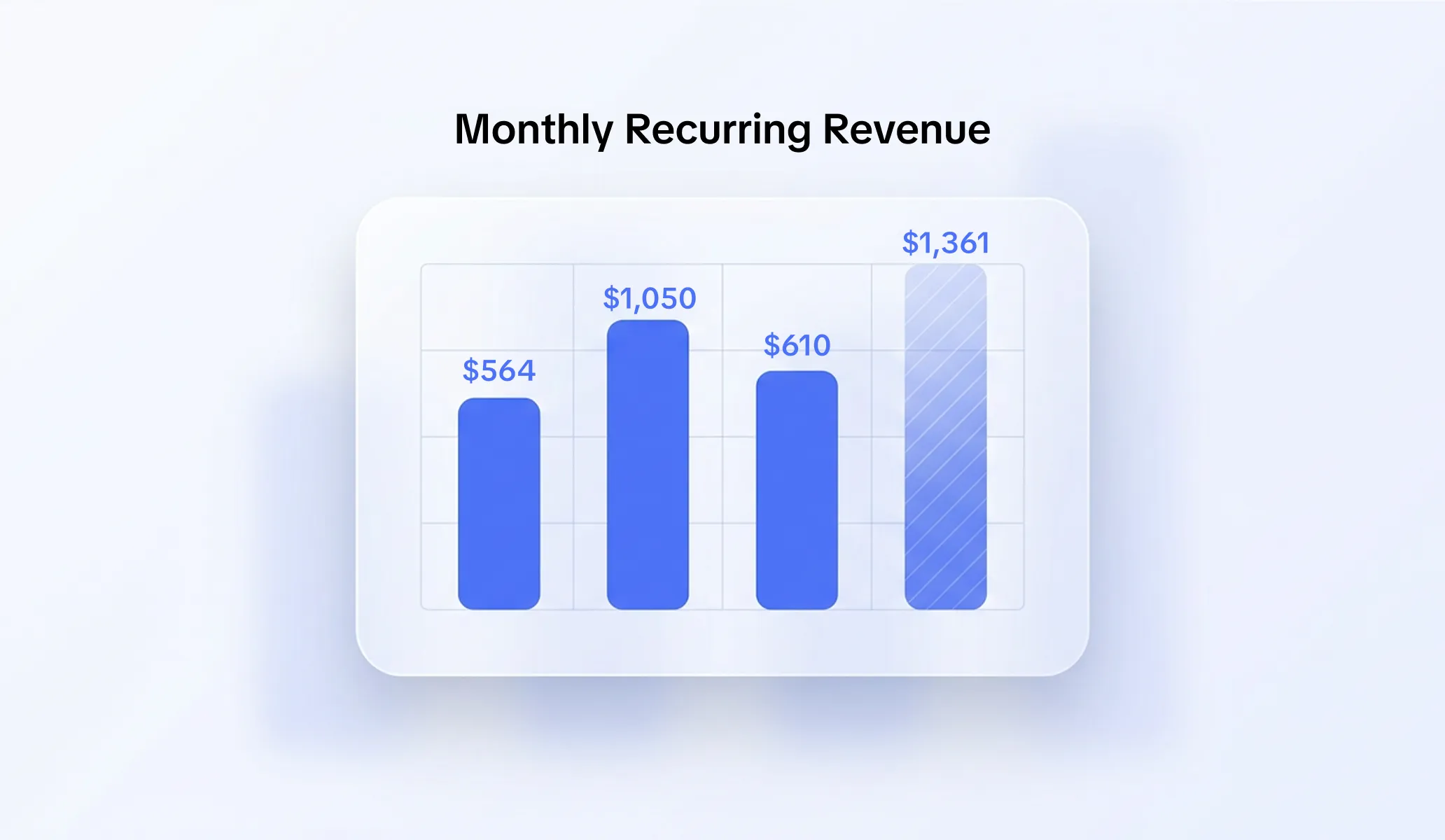
For subscription iOS apps, tools like Subtica (App Analytics, Subscription Analytics, Revenue Analytics, Revenue Forecasting, Cohort Analysis, ARPU, Predictive Analytics) help businesses automatically calculate monthly recurring revenue, track net new MRR, and turn MRR analysis into actionable growth strategy.

What Is MRR (Monthly Recurring Revenue) in a SaaS Subscription Business?
MRR stands for monthly recurring revenue — the predictable recurring revenue generated from paying customers on a monthly basis.
In a SaaS business model, customers pay for a monthly subscription or annual plan, and MRR measures the recurring revenue generated per month from the total number of paying customers.
For SaaS companies and subscription iOS apps, MRR is a key indicator of the health of a business because it reflects:
- Stable cash flow
- Recurring revenue streams
- Revenue generated from subscribers
- Growth of the customer base
What Does MRR Mean?
The meaning of MRR is simple: it represents the total monthly revenue generated from active subscriptions in a given month.
But there are nuanced MRR meanings:
- MRR refers only to recurring revenue generated
- It excludes one-time revenue
- It reflects monthly subscription value
- It indicates predictable revenue
MRR stands as an important metric for subscription businesses because it allows companies to predict future revenue with more accuracy than traditional revenue reporting.
What Is MRR in Finance?
In finance, MRR is a critical recurring revenue metric used by SaaS companies and investors to evaluate:
- Revenue growth
- Customer acquisition efficiency
- Churn rate
- Future revenue potential
MRR calculation allows finance teams to model cash flow and forecast annual recurring revenue (ARR). Because MRR measures consistent revenue per month, it provides clarity into financial stability.
Why MRR Is Important for a Subscription Business Model
MRR is important because it transforms a subscription business into a predictable revenue engine.
Here's why MRR is an important metric:
- It helps analyze MRR growth
- It tracks churn MRR and contraction MRR
- It measures expansion MRR from upgrades
- It shows additional MRR generated from existing customers
- It allows businesses to use MRR to track performance monthly
MRR helps sales and marketing teams align their marketing strategy with measurable revenue growth. Without MRR analysis, subscription businesses operate blindly.

Monthly Recurring Revenue vs Revenue vs ARR
Revenue includes all income: one-time purchases, setup fees, and subscriptions.
MRR vs revenue comparison:
- Revenue = total revenue streams
- MRR = recurring revenue generated per month
- ARR = annual recurring revenue
MRR provides short-term visibility, while ARR reflects long-term recurring value.
MRR vs ARR (Annual Recurring Revenue)
ARR equals MRR multiplied by 12.
If you calculate monthly recurring revenue correctly, ARR becomes a simple extension. However, MRR gives more granular insight into monthly churn, net new MRR, and short-term revenue fluctuations.
MRR vs Annual Recurring Revenue in SaaS
MRR vs annual recurring revenue analysis depends on your business model:
- Early-stage SaaS companies focus on MRR growth rate
- Mature SaaS business operations may prioritize ARR
Still, MRR is important for tracking month-to-month performance.
MRR vs One-Time Revenue
One-time revenue does not represent recurring revenue generated.
MRR excludes:
- Setup fees
- One-off purchases
- Non-recurring consulting services
This distinction protects MRR calculation accuracy.
Is MRR a KPI and Core Business Metric?
Yes. MRR is a key KPI and MRR metric for subscription businesses.
MRR is a critical indicator of:
- Health of a business
- Predictable revenue
- Revenue growth trajectory
- Stability of the customer base
For subscription iOS apps, MRR is a key performance metric tracked daily inside Subscription Analytics dashboards like Subtica.
MRR Formula and MRR Calculation Explained
Basic MRR Formula
MRR formula:
MRR = Total number of paying customers × Average monthly revenue per user
You multiply the total number of paying customers by the average revenue per user (ARPU).
How to Calculate Monthly Recurring Revenue Step-by-Step
- Identify total number of paying customers in a given month
- Determine average revenue per customer
- Multiply the total number by average monthly revenue per user
- Exclude discounts incorrectly applied
- Remove one-time revenue
This MRR calculation ensures accuracy.
How to Calculate MRR for Different Billing Intervals
If customers pay annually, divide annual recurring revenue by 12.
If customers pay quarterly, divide by 3.
This normalizes revenue per month and ensures consistent MRR measures.
How to Calculate MRR with Discounts, Coupons, and Upgrades
Always include discounts in MRR calculation.
Example:
- $100 plan with 20% discount = $80 MRR generated
- Upgrade mid-cycle = adjust expansion MRR
Ignoring discounts leads to inaccurate MRR analysis.
MRR Calculation for Mid-Month Starts and Plan Changes
For mid-month starts:
- Prorate revenue
- Count full recurring value next month
For plan changes:
- Track contraction MRR (downgrade)
- Track expansion MRR (upgrade)
Accurate MRR analysis reflects real revenue movement.

Types of MRR in SaaS Subscription Business
There are different types of MRR that explain revenue movement.
New MRR
Revenue from a new customer subscribing for the first time.
Expansion MRR
Additional MRR generated from existing customers upgrading pricing plans.
Contraction MRR
Decrease in MRR when a current customer downgrades.
Churned MRR
MRR lost due to cancellation. This represents the loss of revenue and directly impacts monthly churn.
Net New MRR
Net new MRR = New MRR + Expansion MRR + Reactivation MRR − Churn MRR − Contraction MRR.
Net MRR indicates real growth.
Different Types of MRR and What They Mean for Growth
Understanding different types of MRR helps businesses:
- Analyze MRR growth rate
- Track reactivation MRR
- Understand decrease in MRR
- Improve MRR through pricing strategy
MRR Growth and How to Analyze MRR
MRR growth reflects revenue expansion over time.
MRR growth rate formula:
(Current month MRR − Previous month MRR) / Previous month MRR
Businesses can also use MRR to track sales and marketing efficiency and customer acquisition effectiveness.
How to Analyze MRR by Cohort
Cohort Analysis allows you to analyze MRR by:
- Acquisition month
- Pricing plans
- Customer lifetime
In Subtica, Cohort Analysis shows how MRR from subscribers evolves across retention periods, revealing churn rate and lifetime value trends.
How to Use MRR to Measure Product-Market Fit
If MRR growth is consistent and churn rate is low, it signals product-market fit.
If MRR would stagnate or monthly churn increases, it suggests retention issues.
MRR analysis combined with ARPU and customer lifetime data reveals whether your subscription business is sustainable.
MRR Growth Rate as a Business Performance Metric
MRR growth rate is an important metric for subscription businesses.
A strong good MRR rate indicates:
- Healthy customer base expansion
- Effective customer acquisition
- Strong retention
How to Use MRR for Financial Forecasting
MRR provides predictable revenue modeling.
Revenue Forecasting tools use:
- Current MRR
- Net new MRR
- Churn rate
- Expansion trends
Subtica's Predictive Analytics helps predict future revenue and ARR based on real-time MRR data.
MRR Table Overview (Key Components & Definitions)
| Component | Definition |
|---|---|
| MRR | Monthly recurring revenue generated |
| New MRR | Revenue from new customer |
| Expansion MRR | Additional MRR generated from existing users |
| Contraction MRR | Revenue decrease from downgrades |
| Churn MRR | MRR lost due to cancellations |
| Net New MRR | Total monthly growth |
Table: Types of MRR and Calculation Logic
| Type | Formula Logic |
|---|---|
| New MRR | New customers × revenue per customer |
| Expansion MRR | Upgrade difference |
| Contraction MRR | Downgrade difference |
| Churned MRR | Cancelled subscription value |
| Net MRR | Combining MRR components |
Table: MRR vs ARR vs Revenue Comparison
| Metric | Scope | Predictability |
|---|---|---|
| MRR | Monthly basis | High |
| ARR | Annual recurring revenue | High |
| Revenue | All revenue streams | Medium |
What Is a Good MRR and What Is a Good MRR Rate?
Good MRR depends on stage and business model.
What Is a Good MRR for Early-Stage SaaS?
For early SaaS companies, consistent MRR growth matters more than absolute numbers.
Good MRR Rate Benchmarks by Business Model
Healthy SaaS companies often target 10–20% monthly MRR growth early on.
B2B vs B2C Subscription Business: How to Evaluate Good MRR
B2B SaaS may have higher ARPU and lower churn rate.
B2C subscription iOS apps focus on volume and optimize average revenue per user.
Common MRR Calculation Mistakes in SaaS
The most common MRR calculation mistakes in SaaS include counting annual recurring revenue at full value instead of allocating it monthly, including trials or one-time revenue in monthly recurring revenue, ignoring discounts when customers pay, and failing to separate new MRR, expansion MRR, contraction MRR, and churn MRR — all of which can distort MRR growth, misrepresent predictable revenue, and give a false view of overall business health.

Including Annual Plans at Full Value Instead of Monthly Allocation
Always normalize ARR to monthly revenue.
Including Trials and Non-Recurring Revenue
Trials should not be counted in total number of paying customers.
Excluding Discounts from MRR Calculation
Incorrect MRR formula inflates numbers.
Treating MRR Like GAAP Revenue
MRR is an operational metric, not accounting revenue.
How to Increase MRR in a Subscription Business
Increase MRR by Optimizing Pricing Strategy
Adjust pricing plans to improve revenue per customer.
Increase MRR with Upsells and Cross-Sells
Drive expansion MRR.
Increase MRR by Reducing Churn
Lower monthly churn and churn MRR.
Increase MRR by Acquiring More High-Quality Users
Improve customer acquisition quality through targeted marketing strategy.
Increase MRR Through Product-Led Growth
Better onboarding increases conversion and new MRR.
How to Use MRR with Other Key Metrics
MRR and Churn Rate
Churn directly affects net new MRR and overall MRR growth.
MRR and LTV
Customer lifetime and lifetime value depend on stable MRR and retention.
MRR and ARPU
Average revenue per user influences total MRR generated.
MRR and Customer Acquisition Cost (CAC)
Customer acquisition efficiency determines profitability of new MRR.
MRR Calculator and Dashboard for Subscription iOS Apps
Subtica's MRR calculator automatically calculates monthly recurring revenue in real time, tracks net new MRR, churn MRR, and expansion MRR, and gives subscription iOS apps a clear dashboard to monitor MRR growth, churn rate, and overall business performance in one place.

How to Calculate MRR Automatically with a Calculator
An MRR calculator automatically:
- Tracks total number of paying customers
- Computes average monthly revenue per user
- Monitors monthly churn
MRR Calculation and Net New MRR Tracking in Subtica
Subtica's Subscription Analytics automatically:
- Calculate MRR in real time
- Track new MRR, churn MRR, contraction MRR, expansion MRR
- Monitor net new MRR
- Analyze MRR growth by cohort
This removes manual spreadsheet errors and ensures precise MRR calculation.
Subscription Analytics for iOS: MRR, ARR, and Cohort Analysis
With Subtica:
- Track monthly recurring revenue
- Analyze ARR and annual recurring revenue
- Perform cohort analysis
- Monitor ARPU and revenue analytics
- Forecast cash flow and future revenue
How Subtica Helps You Calculate MRR and Analyze MRR Growth
Subtica automatically calculates MRR in real time, tracks net new MRR, churn MRR, and expansion MRR, and helps you analyze MRR growth through cohort-based Subscription Analytics and Revenue Forecasting dashboards built specifically for subscription iOS apps.
Built for Subscription iOS Apps
Subtica is designed specifically for subscription iOS apps operating on a monthly subscription model.
Real-Time MRR Calculation and Cohort Insights
MRR helps teams see top-level MRR, nuanced MRR meanings, and detailed revenue breakdowns instantly.
Turn MRR Data into Revenue Growth Strategy
Subtica connects:
- App Analytics
- Subscription Analytics
- Revenue Forecasting
- Predictive Analytics
So businesses can also use MRR to track growth, improve MRR, and drive sustainable revenue growth.
FAQ
Want to Apply These Insights to Your App?
Track subscription metrics, reduce churn, and scale your iOS app revenue with Subtica’s subscription analytics platform.


Related Articles

Subscription Analytics Dashboard for SaaS: Data-Driven Metrics and Revenue Insights for iOS Apps
Subscription analytics helps SaaS and subscription businesses turn data into valuable insight. Learn how subscription analytics software tracks subscription metrics, payments, and performance with customizable dashboards, charts, and one-click reports.
Subtica Team

Subscription Business Metrics to Track: Essential SaaS Metrics for Every Subscription Business
Discover the key subscription metrics every business should monitor. Learn which key metrics SaaS companies and subscription businesses use, the most important metric to track, and how a strong analytics system helps monitor subscription metrics and growth.
Subtica Team

Predictive Analytics Examples, Applications, and Algorithms for Subscription Apps
Predictive analytics helps businesses forecast trends using algorithms and data models. Learn how predictive analytics works, key use cases like fraud detection, and how companies use predictive analytics to forecast future outcomes.
Subtica Team

Predictive Analytics Definition: What Is Predictive Analytics and How It Works
Predictive analytics uses machine learning, data mining, and statistical models to predict future outcomes. Learn the predictive analytics definition and how businesses use predictive analytics with historical data and current data to forecast trends.
Subtica Team

Customer Churn Rate Analysis for SaaS: How to Calculate Churn Rate, Perform a Churn Analysis, and Improve Retention
Learn how to calculate customer churn rate with practical churn analysis techniques. Understand customer churn, revenue churn, and retention metrics while analyzing your churn to improve retention and reduce churn rate.
Subtica Team
ARR Revenue: Annual Recurring Revenue Calculation, Recurring Revenues & How to Calculate ARR for SaaS Business Billing
ARR revenue (annual recurring revenue) is a core metric for subscription and SaaS business models. In this guide to annual recurring revenue, learn how to calculate ARR, understand recurring revenues, and improve revenue growth. Discover ARR calculation methods, why this SaaS metric matters, and how annual recurring revenue supports predictable subscription business performance.
Subtica Team

Mobile App Performance Metrics: Top Metrics, Key KPIs & App Analytics for Mobile App Performance
Discover the most important mobile app metrics to track app performance, user engagement, and engagement and retention. Learn how mobile app analytics metrics, KPIs, and app analytics tools help optimize mobile app performance and drive growth.
Subtica Team

Revenue Management Software: Best Revenue Management Software to Streamline Revenue and Simplify Revenue Management
Learn how revenue management software and modern RMS platforms help subscription apps automate revenue operations, improve forecasting accuracy, and optimize recurring revenue with analytics and AI.
Subtica Team

Mobile App Analytics: How Mobile Analytics Helps Optimize Mobile Apps
Understand how mobile app analytics works, which KPIs to track, and how analytics tools help optimize app performance, user engagement, retention, and subscription revenue.
Subtica Team